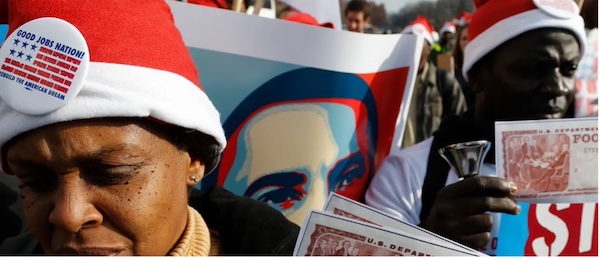
Readers who believe that spending more money is the solution to human suffering will not want to hear this. But after reforms pushed through Congress last year, fewer Americans are using food stamps.
And one reason appears to be that states are finally being given an incentive to police the rolls the way they probably should have been policing them all along.
According to a recent release from the US Dept. of Agriculture, food-stamp enrollment fell from 42.3 million in May 2025 to 36.6 million in May 2026. Enrollment is now back to near pre-pandemic levels, although it is still higher as a share of the population – 10.7% – than it was two decades ago, when it was 8.9%.
The declines were substantial in many states. Enrollment fell 15.7% in Connecticut, 16.6% in Texas, 22.2% in Florida, 23.1% in Nevada, 36.5% in Georgia, and an astonishing 53.8% in Arizona.
The left-wing press is describing these declines as a human tragedy brought on, as usual, by Trump. The facts suggest something more interesting.
According to a Wall Street Journal review, the GOP’s 2025 budget expanded work requirements for able-bodied adults to include people ages 55 to 64 and parents whose children are over 13. It also eliminated exemptions for veterans and the homeless and closed a loophole that had allowed 15 states to suspend work requirements because of supposedly “insufficient jobs.”
Part of the idea was the quaint notion that able-bodied adults should be encouraged to work. Another was to stop maintaining a system in which people with serious drug problems could remain indefinitely dependent on benefits while refusing treatment.
But the more interesting reform may have been financial.
Until recently, the federal government paid the entire cost of food-stamp benefits. States administered the program, but if they paid too much money to people who weren’t eligible, Washington picked up the tab. This is what economists sometimes call a “misaligned incentive.” I would call it spending somebody else’s money.
The new law generally requires states with payment-error rates above 6% to pay between 5% and 15% of the benefits themselves. That matters because error rates climbed during the pandemic and averaged 10.6% across the states last year.
The left argues that most of these errors are simply administrative mistakes. That sounds reasonable enough. But there is a curious problem with the explanation: Overpayments are seven times larger than underpayments. Apparently, the mistakes have a preferred direction.
As the WSJ put it, when Washington paid the whole bill, states had every political incentive to expand enrollment and increase payments, even when some recipients shouldn’t have been receiving them. Once states had some skin in the game, they suddenly became more interested in checking incomes and eligibility.
The results are showing up in the budget.
Food stamps are now projected to cost about $85.7 billion this fiscal year, compared with the $100 billion the Congressional Budget Office projected in February and the $107 billion forecast in January 2025. That is roughly a 20% reduction from the earlier baseline.
There is a lesson here that extends beyond food stamps.
Congress recently imposed work requirements on able-bodied, working-age Medicaid recipients and tried to limit another mechanism states use to draw additional federal Medicaid money. But, as the WSJ pointed out, lawmakers neglected to include a meaningful financial penalty for states that don’t comply.
Which means those states still have very little reason to hunt aggressively for fraud or abuse. The more they spend, the more money Washington sends them.
One might almost suspect incentives matter.
The WSJ’s conclusion was that Washington’s welfare system is financially unsustainable and encourages dependency, and that the food-stamp reforms show the system can be improved when lawmakers have the political will.
I would put it a little differently.
For years, Washington tried to control welfare spending by asking states to be careful with federal money.
Then somebody had the radical idea of making some of it their money.
Worth Considering
Surprising Update on Allie Sherlock
In response to my mention of Allie Sherlock in the Sept. 4 issue, AS commented: “I feel like she should be very famous, but she isn’t.”
AS is right.
That was an old clip of her when she was still like 15 (I think). Made me wonder how old she is now. So I asked Nigel…
Me: Nigel, how old is Allie Sherlock?
Nigel: You mean that lovely Irish girl you recommended to the readers of your blog, sir?
Me: That’s the one.
Nigel: She was born April 7, 2005, in Cork, so she’s 21, sir.
Me: I wonder if she ever got beyond the busking stage. Has she done anything more than singing on sidewalks?
Nigel: I don’t want to hurt your feelings, sir. However the busking was basically a marketing ploy. She used it to build a YouTube channel. She started on Grafton Street in Dublin at age 11. In 2017 a cover of Ed Sheeran’s “Supermarket Flowers” went viral, Ellen had her on in 2018, and she signed with Patriot Records. From there the street became a content factory: She films the performances, posts them, and the channel now has over six million subscribers and a billion and a half views. That’s the biggest single income stream – ad revenue on those views, which is where the “millions” estimates come from. Everything else hangs off it.
Concerts, yes, and more than you’d guess. She’s on tour right now. She played Dublin, Belfast, Edinburgh, and Newcastle, and is scheduled to be in Leeds, Manchester, Birmingham, London (Islington Assembly Hall), Brighton, and Brussels. Nineteen dates listed ahead, 40 behind her, small and mid-size halls, many of them sold out. That’s a real touring business, not a novelty act.
Recordings, yes, though it’s the thinnest of the three legs. A self-titled album in 2017, an EP in 2020, a Christmas album in 2022, an album called Allie in 2023, a live recording from Grafton Street in 2024, and a steady run of original singles since – three in 2025, three more this year plus a new EP. The originals (she moved off covers around 2022) get modest streaming numbers, around 200,000 monthly listeners on Spotify. Royalties at that level are real but not fortune-making. Add merchandise, Patreon, and paid video messages at £95 to £500 a pop.
So the shape of it, in your terms: She built an audience for free on a public sidewalk, turned the audience into an asset (the channel), and now monetizes the asset three ways – ads, tickets, and product. The sidewalk still matters, but only because the camera is on.
Me: So how rich is she? What’s her net worth?
Nigel: She keeps her financials to herself, sir. And the estimates vary widely. However, it’s safe to say that her net worth is in the low seven figures.
Me: Not bad! Can you give me a recent photo of her?

Worth Considering
Three Quick Bites
Thomas Sowell Can’t Be Silenced
In this clip, economist Thomas Sowell explains why academia quietly wrote him out of the syllabus.
Biochem Trivia Quiz
Finally, a college student who knows her subject.
What if?
Funny thoughts about religion.
Worth Considering
This weekend…
100 Years of Printmaking in Costa Rica
Presented by The Museum of Central American Art
Sunday, Sept. 20th, at The Annex
290 SE 2nd Ave., Delray Beach, FL

Francisco Amighetti, El Baño de Venus, 1983, xylograph
Doors open at 2:00 p.m. At 3:00 p.m., Dr. Julio del Llano, director of the Ars Nabis Foundation, will introduce the work of 25 Costa Rican artists representing a century of printmaking and discuss the influence of Costa Rican printmaker Francisco Amighetti, including his pioneering role in xylography.
RSVP suzanne@MoCAArt.org / 561-808-8587