In the first three installments of this report, I’ve been making what may seem like a depressing argument.
Artificial intelligence is rapidly reducing the economic value of stored knowledge and many kinds of human thinking. Lawyers, accountants, designers, programmers, consultants, writers, and even doctors are beginning to compete with machines that can perform much of the same intellectual work faster, cheaper, and, increasingly, better.
If that’s true, one obvious question follows: Where does that economic value go?
History gives us reason to be optimistic. Every previous technological revolution ultimately created enormous new wealth. The plow. The steam engine. Electricity. The automobile. The computer. The internet.
Every one of them destroyed existing industries, but every one of them also created new industries, new professions, and new fortunes that more than compensated for what was lost.
Perhaps AI will do the same. I hope it does. But I don’t know… and I don’t think anyone else does either.
Previous technological revolutions expanded the economic pie in several ways. They created entirely new industries to manufacture, operate, repair, and improve the new technologies. They dramatically increased the number of people who could afford products and services that had once been too expensive. And they spawned entirely new businesses that no one could have imagined before.
AI will almost certainly do some of those things. The question is whether it will do enough of them to offset the unprecedented speed with which it is reducing the economic value of human knowledge and thinking.
I don’t know the answer. Fortunately, the argument I’m making in this report doesn’t depend on it. Whether AI doubles the size of the economy, increases it only modestly, or barely increases it at all, one thing seems almost certain: Economic value is going to migrate.
Every technological revolution changes what the marketplace rewards. The plow reduced the value of brute strength and increased the value of farming skill. The Industrial Revolution reduced the value of hand craftsmanship and increased the value of engineering, manufacturing, and management. The Information Revolution made knowledge processing enormously more efficient and dramatically increased the economic value of the people and businesses that built, operated, serviced, and owned those information machines.
The AI Age is changing that equation again. The only discussion worth having now is this: What will the marketplace value next?
I believe the answer begins with a simple observation. AI is changing much about how humans live and the economic choices we make. But it will not change our fundamental social and psychological needs.
At first glance, that may not seem like a particularly profound observation. But I believe it explains where much of the economic value created by AI is going to migrate over the next decade.
Consider how economic value is distributed throughout world populations. In what is called “developing countries,” the bulk of consumer spending is on physical necessities, like food and shelter. But in prosperous countries, the lion’s share of consumer spending is on discretionary spending – which could be described as things that satisfy human wants.
This is Psychology 101 for marketers. It is also basic knowledge for anyone who has studied Maslow’s Hierarchy of Needs. What I say when I’m teaching rhetoric to fledgling essayists and copywriters is that even among things we consider to be necessities, like food and shelter, 80+% of consumer spending is on psychological and social wants, not physical needs.
We buy larger homes than we need, better cars than we need, expensive vacations, jewelry, designer clothing, and thousands of other products and services that contribute very little to our physical survival.
We buy a $1,000 watch that is no better than a $29 watch because the $29 watch cannot satisfy our psychological and social need for prestige. We join private golf clubs and send our children to private schools.
We do it because we are concerned with where we stand within the communities we belong to. We want/need to be respected. We want/need to attract mates. We want/need to earn the trust of others. We want/need to protect our families. We want/need to feel competent. We want/need purpose. We want/need meaning.
Where does all that economic value go?
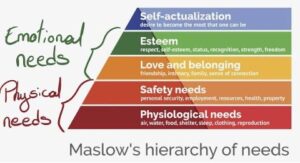
For most of human history, nearly all of our productive effort was devoted to satisfying physical needs. Food. Shelter. Clothing. Transportation. Heat. Security. Medicine. If you had asked a farmer living 300 years ago what he wanted out of life, almost everything on his list would have been connected to survival.
As societies became wealthier, something remarkable happened. The percentage of our income devoted to satisfying physical needs began to decline.
Food became cheaper. Clothing became cheaper. Transportation became cheaper. Communication became cheaper. None of those things became less useful. They simply became easier to produce.
That’s what technology normally does. It increases abundance. And when abundance increases, prices usually fall.
Which brings us back to the question we began with: If AI is making knowledge and analytical thinking more abundant, what happens to the value of human intelligence? My answer is that, as with anything else, it will migrate toward whatever remains relatively scarce compared to demand.
That doesn’t mean human intelligence becomes worthless. It means the marketplace begins paying less for intelligence that has become widely available. Exactly the way it paid less for manufactured goods once factories learned to produce them by the millions. Exactly the way it paid less for information once computers and the internet made information nearly free.
The question, then, isn’t whether human knowledge and intelligence will continue to matter. Of course it will. The question is: “Where will the high economic value associated with it now go?
And my answer is that it will go toward all the inextinguishable social and psychological needs that have always existed. I’m talking about acceptance and inclusion, approval and affirmation, admiration and respect, recognition and acknowledgment, gratitude, vindication, forgiveness, etc.
And along with those needs, high economic value will migrate to those that can provide them – educators and coaches, influencers and gurus, analysts and explainers, thought leaders and motivational creators, charismatics and celebrities. So long as they have an audience to work their magic on, and so long as and to the degree they can win the trust and approval of an increasingly large group of fans and followers, these people will do well.
But that’s not where the real wealth will flow.
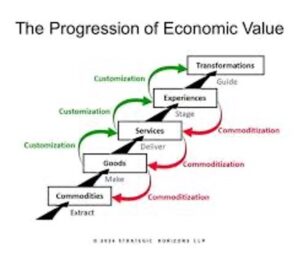
As technology makes it less expensive to satisfy our physical needs, a growing share of our spending naturally shifts toward satisfying our psychological and social needs.
It’s been happening for generations. And artificial intelligence, I believe, is going to accelerate it. Not because our physical needs disappear – they never will – but because satisfying them becomes progressively less expensive. As that happens, more time, attention, and money becomes available for satisfying the psychological and social needs that have always been there.
When Trust Becomes the New Currency

If my prediction is right, AI is going to create a world in which information is almost unimaginably abundant. Every question you ask will produce dozens of intelligent answers. Every product will have hundreds of reviews. Every investment idea will come with persuasive arguments for and against it. Every medical recommendation will be accompanied by impressive-looking research. And because AI can already generate realistic photographs, voices, and videos, it will become increasingly difficult to distinguish the authentic from the artificial.
At first, I thought this would simply make everyone smarter. The more I thought about it, though, the less convinced I became. The internet already gave us access to more information than any previous generation could have imagined. Has it made us more certain about what is true? It doesn’t seem like it. If anything, many of us are less certain. We don’t suffer from a shortage of information. We suffer from an excess of it.
I think AI will magnify that problem enormously.
The result, ironically, won’t be less demand for human advice, it will be more. Faced with an endless stream of plausible answers, most people will do what they’ve always done. They’ll look for someone they trust to help them make decisions.
When I use the word trust, I don’t mean blind faith. I mean the willingness to listen to someone else’s advice and act on it.
All of us do this every day.
We trust one physician over another because that’s who so-and-so uses. We have a favorite financial writer because his opinions tend to agree with our own. We ask one friend for restaurant recommendations and another for travel advice. We build a mental list of people whose judgment we rely on in different parts of our lives.
That tendency isn’t going away. If anything, it’s going to become stronger.
The AI Age Is a Tribal Age – an Age of Digital Nations

That leads to another thing I’ve been thinking about…
We are all members of multiple tribes, even if we don’t think of them that way. Followers of a favorite podcaster are a tribe. Readers of a newsletter are a tribe. Members of a golf club, a church, a business association, or an online community are tribes. They are groups of people who look to one another for clues about what to buy, what to believe, and how to act.
But I suspect the more interesting opportunity lies elsewhere.
The AI economy is going to create millions of smaller tribes, each built around a trusted voice. The entrepreneurs who learn how to earn that trust, build those communities, and serve them honestly will own one of the few assets that AI cannot mass-produce.
If the central economic story of the AI Age is that intelligence becomes abundant, I think the central business story will be that trust becomes scarce.
And scarcity is where economic value always goes.
When Digital Tribes Become the Dominant AI Businesses

I’ve been using the word tribe to describe the communities that will be created by the AI economy, although I don’t mean tribe in the anthropological sense. I mean something much broader: a group of people that consciously or unconsciously look to one another – and especially to trusted leaders within the group – for clues about what to buy, what to believe, and how to behave.
Once I began thinking about tribes that way, I started seeing them everywhere. Religious groups – and particularly the fundamentalist sects – are essentially tribes. So are Hell’s Angels and some Harley-Davidson riders. So are some Cross-Fit/ Paleo Diet/ Vax/ Anti-vax adherents, and superfans of YouTube pundits that have large followings, like Jordan Peterson, Ben Shapiro, Ezra Klein, Rachel Maddow.
Now that I think of it, one could say that, since 2016, the entire US population seems to have formed itself into two mega-tribes: Trump fans and Trump haters.
This isn’t brand-new. Human beings have organized themselves into tribes for hundreds of thousands of years. Long before there were cities or nation-states, belonging to a group improved your chances of survival. It helped you find food, choose a mate, defend against enemies, and raise children. We may carry smartphones instead of spears today, but our brains still seek many of the same social cues they sought thousands of generations ago.
What has changed, I believe, are four things:
1. The number: Thanks to the World Wide Web and the almost universal use of social media, the number of tribes has increased enormously.
2. The medium: Although local, in-person tribes still exist, the lion’s share exist in digital platforms.
3. Belief systems: Because of the nature of social media algorithms, the values, beliefs, and objectives of digital tribes are stronger than ever.
4. The size: Until the Digital Age, the large tribes were primarily religious. Now there are hundreds – no, thousands – of tribes that comprise millions, and tens of millions, of members.
There is also another sort of tribe whose social values, beliefs, and objectives are not always evident, but – thanks to embedded social media algorithms – operate in similar ways. I’m thinking of Google, Apple, Facebook, X, etc.
Consider the reach of these communities: Apple has hundreds of millions of loyal customers. Google influences billions of people every day. X, YouTube, Instagram, TikTok, and dozens of other platforms have created communities whose populations exceed those of most countries.
I see businesses like these as digital tribal nations, because some of them are as large and in some ways as powerful as sovereign, physical nations – and in some ways, more efficient.
After all, they collect revenues, establish rules, sanction rule breakers, and reward desired behavior. (Digital tribal nations don’t imprison people or execute rule breakers, of course. They simply impose the punishment that used to be considered worse than imprisonment or execution by the ancient Greeks: ostracism. They remove them from the community, either temporarily or permanently.)
I do not foresee great changes in these digital tribal nations in the AI Age. They’re already built. They are already huge. They are already making billions of dollars.
However, I do foresee enormous growth and opportunities for the digital tribes that are one and two steps below them – the large social media platforms. And I foresee significant growth among the third-tier tribes – the pundits, teachers, influencers, and celebrities that have hundreds of thousands of followers and the knowledge and skills to exact revenue from them on a voluntary basis. But I believe the greatest opportunities will be among smaller businesses that have only a few thousand prospects and/or customers now and understand how they can increase their communities 10-fold or 100-fold and also learn how to “tax” them.
Artificial intelligence is about to reduce the cost of creating content to near zero. That means almost anyone will be able to produce articles, videos, podcasts, courses, newsletters, books, and software that look professionally made.
At first glance, that sounds like terrible news for entrepreneurs. Not necessarily so.
As content becomes abundant, communities become scarce. People won’t be looking for another 1,000 videos about investing or nutrition or fitness. They’ll be looking for judgment they trust and people who share their interests and values. That’s a completely different business.
For 40 years, I’ve argued that the most valuable asset many companies own isn’t their office building or their equipment. It’s their customer list – people who had responded to their offers in the past and bought products/services from them. I believe that will become even truer in the AI Age. Because a responsive list isn’t merely a marketing tool. It’s a tribe. And tribes are extraordinarily valuable because they dramatically reduce the cost of communication. If you have earned the trust of 100,000 people and you can reach them instantly by email, text message, podcast, or whatever replaces those technologies, you’ve built an economic asset that AI cannot simply manufacture.
There’s another distinction worth making.
Many people will earn an excellent living by helping companies build tribes. They’ll become copywriters, community managers, video producers, AI specialists, brand strategists, and marketers. Those will continue to be valuable skills. But the greatest fortunes won’t be made by the people building tribes for someone else. They’ll be made by the people who own the tribes. That’s how it has always worked.
Employees are paid for their skills. Owners are rewarded for the value of the asset they’ve built.
A trusted tribe doesn’t have to be enormous to become extraordinarily profitable. If only 10% of your 100,000-member tribe eventually spends $50 or $100 a year on your products or services, you’ve created a business capable of generating millions of dollars in annual revenue.
That’s why I think tribe-building will become one of the defining entrepreneurial skills of the AI Age.
The technology will change. The platforms will change. The tools will change. But human beings won’t change. They will still be looking for people they trust. They will still be looking for communities where they feel they belong. And wherever human beings gather to seek guidance, belonging, and trusted judgment, economic value will follow.
The New Wealth Builders

In Part 2 of this report, I predicted that only a small portion of the population would prosper in the AI Age. “Perhaps 20% will become dramatically more valuable by learning to evolve with AI,” I said. “The remaining 80% won’t disappear, but I think many of them will discover that the market no longer values their knowledge the way it once did.”
What does that mean for you? What advice can I give you on becoming one of the fortunate 20% and avoiding living through the AI Age as an underpaid, underappreciated 80%-er?
When I began thinking about this question, I made the same mistake I suspect you may be making. I started by making a list of industries that seem likely to see the value of their products and services most reduced by AI: Law. Accounting. Human Resources. Research. Healthcare. Defense. Education. Law Enforcement. Graphic Arts. Music. Science. Technology. Even Entertainment.
Next, I thought to identify the industries that are likely to see a significant increase in sales in the next several years due to the historic levels of corporate and government spending that is being poured into AI today.
But I realized that none of that was going to be a big help to you – because the real question we need to answer is not simply what industries will survive and thrive, but what sorts of people will create the most economic value in any industry. And I’ve suggested who they are: The people that know how to efficiently grow the size of digital, tribal communities. The people that have the skills to become not just trusted educators, advisors, consultants, and coaches of those communities, but salespeople too. And above all, the people that own those tribal communities.
One could argue that this has always been true, that in past technological revolutions, the people that became the richest were those who owned scarce and in-demand services. In the Industrial Revolution that meant the men who owned and/or controlled the factories, railroads, oil fields, and manufacturing businesses. During the Information Revolution, it increasingly meant software companies, communication networks, databases, and intellectual property.
The AI Revolution will mean the extinction of dozens of industries, hundreds of professions, and millions of jobs. But while it is doing that, it will be opening income-making and wealth-building opportunities for millions of individuals that are willing to accept the inevitability of the coming changes and build professions and businesses around this new technology.
If that’s where wealth is likely to be created, where should you begin looking for wealth-building opportunities today?

To take quick and full advantage of these opportunities, you should learn some of the basics – e.g., how to prompt LLMs and build agents. You don’t need to master these skills, because you won’t need them in another year to 18 months. But you do need to become comfortable working with them, so that as AI systems advance in the future – and they will advance in leaps and bounds with every passing month – you don’t feel completely bewildered and left behind.
AI is improving its ability to respond to non-technical human conversations at the speed of sound. And based on what I’m seeing now from my own experience, it won’t be long before you will be able to get AI to do whatever you want simply by switching on your computer, hitting a couple of buttons, and talking.
In the meantime, I’d like you to think about this…
In the not very distant future, there will be thousands of highly paid employees who know how to use AI brilliantly. There will be far fewer owners of businesses that use AI to solve valuable problems for millions of customers – nd history suggests the owners will accumulate most of the wealth.
AI copywriters, designers, programmers, teachers, and community managers – these are all promising careers. But they’re still careers. The real opportunity lies higher up. Can you build something that works while you’re asleep? Can you create a business that continues creating value whether you’re working that day or not? Can you own the customer relationship instead of renting it? Can you own the tribe instead of merely serving it?
Those are the questions you should be asking. Because the answers will determine whether you can become one of the 20% or be left with all your accumulated knowledge and antiquated thinking skills, trying to peddle your economic value in a marketplace that no longer puts much value in what you have spent your life developing.
If I were 25 years old today, I don’t think my dream job would be working for the world’s largest company. I’d want to own a small business with a devoted audience, a trusted reputation, recurring revenue, and AI doing much of the routine work behind the scenes.
That may not sound as glamorous as building the next trillion-dollar technology company. But history suggests that thousands – no, tens of thousands – of such businesses will quietly create extraordinary wealth over the next 20 years.
Get there before everyone else does!
Economic value is migrating. AI is accelerating that migration. Trust, communities, and ownership are becoming more valuable. So, what exactly are you supposed to do about that?
There is one lesson that has repeated itself throughout my business career often enough that I no longer think of it as a theory:
The biggest fortunes created by periods of rapid change almost always go to the people who understand the direction of the change before everyone else does. They don’t possess a crystal ball, and they rarely predict every important development correctly. But they recognize that the center of economic gravity is moving, and they begin moving with it while most people are still arguing about whether the change is real.
When the automobile arrived, fortunes were made in manufacturing cars, building roads, refining gasoline, producing tires, opening roadside hotels, and operating service stations. Those entrepreneurs weren’t united by a common business plan. They were united by a common insight. They recognized that transportation was shifting from horses to automobiles, and they positioned themselves accordingly.
The same pattern repeated itself during the Information Revolution. Some entrepreneurs built computers. Others wrote software. Others created databases, communication networks, or entirely new businesses that depended on inexpensive computing power. Again, the individual opportunities differed, but the underlying insight was the same. They understood where economic value was heading before the migration became obvious.
I believe we are standing at one of those moments again.
I have had conversations about this with dozens of successful people, including people that know more about AI than I do. And I’ve found that a surprising number of them are only interested in talking about questions that, while interesting, seem secondary to me. As in “Which AI model will dominate?” Or “Which company will produce the best chips?” Or “Which application will become indispensable?”
Those questions matter, but I doubt they will determine who benefits most from the next decade.
To me, the more useful question is much simpler: Where is economic value moving, and how can I begin moving in that direction before everyone else?
Thinking about it that way changes almost everything.
If intelligence is becoming increasingly abundant, assets built upon scarcity deserve more attention. If trust becomes harder to earn and more valuable once it is earned, building a trusted relationship with an audience becomes a more attractive business than simply producing information. If AI lowers the cost of starting and operating a business, ownership becomes even more desirable because a single entrepreneur can create value on a scale that once required an entire organization.
Notice that none of these conclusions depends on predicting exactly what AI will look like five or 10 years from now. They depend only on understanding the broad direction of the migration and positioning yourself accordingly.
That’s what I meant when I said, in Part 1 of this report, that I was looking at several asymmetrical bets to play in this technological revolution that would put me on the right side of the economic shift.
Something That You Can Do Now… Today!
An asymmetric bet doesn’t require certainty. It requires recognizing a major trend early enough that even an imperfect understanding of the details can produce extraordinary results. The exact winners and losers will vary. New technologies will surprise us. Some companies that look invincible today will disappear, while others that barely exist will become giants. Those uncertainties are unavoidable. What matters is placing yourself where the odds increasingly work in your favor.
Looking back over my career, I didn’t know which direct-marketing companies would become dominant or which marketing campaigns would produce the biggest winners. What I knew was that the field that I was working in – direct response marketing – had the mechanisms to find the answers to those questions by the very humble, but very reliable, discipline of generating hypotheses and then testing them with strict controls and samples large enough to make bets on.
I feel much the same way about AI.
I don’t know which companies will dominate a decade from now, and I certainly don’t know every invention that lies ahead. What I think I understand is the direction in which economic value is moving. That understanding, if it proves broadly correct, is more valuable than correctly guessing the next fashionable technology, because every important decision about careers, businesses, investing, and entrepreneurship can be measured against the same question: Does this move me closer to where economic value is going, or does it tie me more tightly to where economic value has already been?
I’ve spent all four installments of this report trying to answer what I believe is one of the most important economic questions of our lifetime: What happens when intelligence itself becomes abundant? I’ve tried to distinguish between what I think I know, what I think is likely, and what I simply can’t predict.
But artificial intelligence is moving quickly. New breakthroughs appear almost weekly. New companies emerge overnight. Entire professions are beginning to change before we’ve finished understanding the last round of changes.
That means something else is becoming valuable. Not just information. Not just intelligence. Collective intelligence.
Over the past 40 years, I’ve been extraordinarily fortunate to work with some of the smartest entrepreneurs, investors, marketers, scientists, technologists, and business builders in the world. Time after time, I’ve watched the same phenomenon repeat itself. One thoughtful conversation produces an idea. Ten thoughtful conversations produce a new way of seeing the world.
I have opinions. I have experience. I have a network of remarkably accomplished friends and colleagues who are wrestling with exactly the same questions we’ve been discussing throughout this report. Many of them have already built extraordinary businesses. Many are already using AI in ways that most people haven’t even imagined possible. Others are making mistakes that all of us can learn from.
What I’ve been doing myself to get ready for what’s to come is almost embarrassingly modest compared to the urgency I feel. The main thing I’m doing is something I’ve mentioned before – getting together with about 16 AI brainiacs at my private cigar club on Friday nights.
People begin to drift in after work, from about 5:30 to 6:30, at which time I make sure that everyone is comfortably seated and correctly equipped with the cigar and alcohol of his choosing. After some preliminary chats about this and that, the AI conversation begins.
Considering the evening’s topic is singular (AI), the range of the conversation is extensive and surprisingly diverse, ranging from true stories of amazing accomplishments to disturbing fears, exciting and positive predictions, and accounts of what each member of the group is working on to claim a perch in the future. It is all – at least for me – very positive and edifying. There is never a Saturday morning that I wake up without two or three new ideas about something I should get working on right away.
Although we differ about how the AI Revolution is going to change the world, we are all agreed that it will change it in very deep and very permanent ways, and that it is likely leave the world’s populations divided into two groups: a large group that will be unprepared and will have to take what is given to them, and a smaller group that will have positioned themselves to be the owners and operators of the new economic order.
As you know, my prediction is that we will be looking at an 80/20 population split – so I started calling these Friday night “meetings” the 80/20 Club.
At this point, the club has no formal goals or objectives. But it’s clear to us that what we are hoping to accomplish is to help one another make sure that, when split occurs, we will be among the fortunate 20%.
Why am I bringing this up?
Because I’ve been thinking that it might be productive – and fun – to expand the club beyond our small group. My idea for doing it is to have an auxiliary group of members who will be able to participate by attending our meetings via Zoom and also by taking part in some sort of email exchange.
I have had many good experiences starting and participating in clubs.
My first significant success in the information publishing industry came in 1982 when I launched an investment club that was a big hit from the start and is still very successful, with more than 100,000 members all over the world. More recently, I was invited by a friend and colleague to join a small group of economists, bestselling authors, and distinguished university professors who had the common bond of being free-market advocates and natural contrarians, a combination that has made for fantastic meetings (on Zoom). I feel privileged to be part of this group, and it is that, I think, that prompted me to consider doing something similar with the momentous topic of the AI Revolution.
I’m not entirely sure this is a good idea, so I’m not launching the 80/20 Club officially just yet. But if it seems like something you would be interested in being a part of, let me know.
You can share your thoughts with me here.
Worth Considering
Three Quick Bites
Is Britain still a free country?
In this video from PragerU, Jeremy Boreing sits down with journalist Andrew Gold for a discussion about what Gold sees as the unravelling of Britain, and why he believes Americans are watching a preview of their own future.
Just the Facts
Foolishness: The Democratic Socialists of America believe that restaurant food prices are high because restaurant owners are greedy.
Fact: According to the National Restaurant Association’s (NRA) State of the Restaurant Industry 2026 report, 42% of restaurant operators reported their establishments were not profitable in 2025 – up from 29% in 2024.
This is insane!
Last week, the FDA approved Moderna’s first-ever mRNA flu shot… despite a 75.3% adverse reaction rate. According to the FDA briefing document, severe systemic reactions were four times MORE COMMON with the mRNA shot than with the traditional flu shot. Read more here.
Worth Considering
Postscript: Have you ever heard of Einstein’s rock paradox?
I hadn’t… until I saw this.