This is crazy!
Either one of these stories would have had me riveted to the news, looking for explanations and follow-ups. But both of them? In the same week? I don’t know what to make of it. But I do know that they are stories every American investor should be aware of.
Here are some of the facts. Read them and tell me if we shouldn’t be alarmed.
First, Paraguay
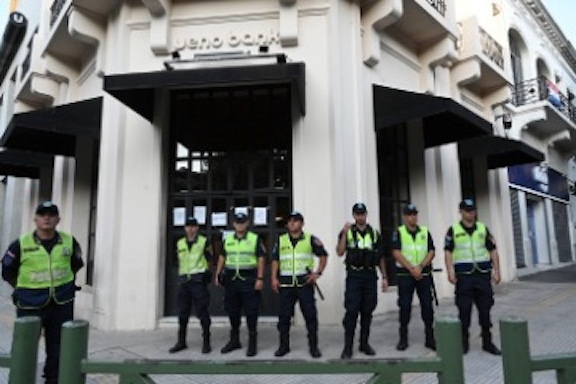
On Tuesday, Nov. 3, Ueno Bank, one of Paraguay’s largest banks, reportedly collapsed after regulators discovered serious problems with its lending practices and capital reserves. The bank had about three million customers in a country of just 7.1 million people. Suddenly, those customers couldn’t get their money.
Think about that. Millions of people who thought their savings were safe woke up to discover they couldn’t get them. Businesses couldn’t access the money they needed to operate. People took to the streets, demanding their savings back.
And then things got even stranger.
The country’s president, Santiago Peña, who had longstanding business connections with the bank’s owners, reportedly offered to resign. Congress refused to accept his resignation, preferring to pursue impeachment proceedings.
Imagine the political and economic turmoil that would cause here.
Now, Japan

On Friday, Nov. 6, a computer-system failure reportedly disrupted operations at 128 Japanese financial institutions, affecting 3,430 branches. Customers couldn’t withdraw money from ATMs. They couldn’t make deposits. Many couldn’t conduct ordinary banking transactions. The official explanation was an equipment malfunction in a shared computer network. Authorities said it wasn’t a cyberattack, and services were restored after about five and a half hours.
So, two banking emergencies in two countries, thousands of miles apart, within three days. Are they connected?
In Paraguay, the problem was financial. In Japan, it was technological. But here’s what bothers me. In both cases, people who thought their money was safely deposited in a bank suddenly discovered they couldn’t get it.
I’ve lived through enough financial crises to know that banks can fail. And I’ve had enough experience with computers to know that they can fail, too. So the failures per se do not merit panic. However, the scale of these two events, happening so close together, makes me wonder how vulnerable our banking systems are today – despite the regulatory and technological safeguards that have been put into place in many countries.
Could something similar happen here? Of course it could. And although I’m not predicting a banking crisis, I’m certainly interested in knowing more about what happened in these two countries. Because these stories remind me of something we investors tend to forget:
There’s a difference between having money in the bank and being able to get your hands on it.
Politics
Did America really change its mind about Trump?
Or did millions of his supporters simply stay home?

Supporters of South Carolina Democratic Senate candidate Dr. Annie Andrews cheer during her election night watch party
I’ve been reading analyses of Tuesday’s Democratic landslide – and there’s something about the way political analysts analyze elections that seems wrong to me.
In this last case of “the blue wave,” for example, all the talk was about how everyone was turned off by Trump’s war in Iran and his import duties and other issues that contributed to inflation. But I believe that the vast majority of voters – on both sides of the aisle and including those with college degrees – have nearly zero knowledge of how import tariffs work or what inflation really is (as opposed to rising prices) or what causes it, let alone anything to do with the causes or objectives of the Iran war.
Those who like to think of themselves as intelligent and capable of understanding such topics aren’t actually capable of understanding them at all. What they can do is get a sense for whose side of any political, social, or economic argument they want to be on, and then quote factoids that come from the hired writers who are paid to cook them up.
Moreover, I don’t believe that among the 10% of voters that do understand the basics of economics, the vast majority would vote for the other side even if they were upset with some of the things their party’s candidates did in fact do. In other words, I don’t think people change their political beliefs very often.
Think about your own experience. How many people do you know who were committed Democrats five years ago and are now committed Republicans? Or vice versa? I know a few. But very few.
And when I think about the very few people I know who have admitted to being unhappy with their party’s actions, none of them joined the opposition. What they more typically do is gripe and then either vote along party lines or (and this is key to what I’m saying today) more likely stay home and not vote at all.
And that brings me to the point of this essay.
My argument is that what really determined the results of the 2026 midterm elections was about Republicans not showing up to vote, rather than changing their minds about the issues they’ve been defending for two years.
What the Numbers Tell Us
Let me see if I can support that idea with some facts, starting with the popular vote.
In 2024, Donald Trump received 77.3 million votes. Kamala Harris received 75 million. In Tuesday’s midterms, according to preliminary national House totals available Friday, Republican candidates received about 48.7 million votes, compared with 63.2 million for Democrats.
That’s a Democratic advantage of roughly 14.5 million votes. Quite a reversal.
But look at the change in the number of votes each party received. The Republican total was about 37% lower than Trump’s 2024 total. The Democratic total was about 16% lower than Harris’s.
That’s a difference of 21 percentage points.
Now, I know what you’re thinking. I’m comparing a presidential election with a midterm election. And presidential elections attract millions of people who don’t bother voting in midterms.
Exactly. That’s the phenomenon I’m interested in.
My suspicion is that when a party wins the presidency, many of its supporters feel they’ve accomplished what they wanted. They go back to their lives. They may be disappointed in some of the president’s decisions, but they don’t feel the same urgency to vote again. Meanwhile, the opposition is furious. Its supporters have spent two years complaining about the president and waiting for a chance to strike back. When that chance comes, they show up.
This may help explain why the president’s party has lost House seats in almost every midterm election since World War II.
But that’s just my theory. Is there any evidence for it?
How Many People Actually Switch Parties?
I began with an assumption: In any given election, fewer than 5% of voters switch from one major party to the other.
I wasn’t sure whether the research would support that number, but then I found a Pew Research Center study of the 2022 midterms. Pew followed voters who participated in the 2020 presidential election and examined what they did in 2022. Among those who voted in both elections, only 6% crossed party lines or voted for a third-party candidate in either election.
And here’s the part that interested me most. Pew concluded that the Republican gains in 2022 were driven primarily by differences in turnout. In other words, Republicans gained ground largely because their supporters were more likely to vote.
That was encouraging. But I wanted to know whether the pattern held up in other elections.
Pew’s research on the 2020 and 2024 presidential elections found something similar. Of the people who voted for Trump in 2020, only 3% switched to Harris in 2024. Another 11% didn’t vote. Among Biden’s 2020 voters, 5% switched to Trump, while 15% stayed home. In both groups, staying home was about three times as common as switching parties.
And then I found something else.
Americans Have Become More Loyal to Their Parties
Political scientist Corwin Smidt studied party switching in presidential elections going back to the 1950s. His research, published in the American Journal of Political Science, found that Americans have become increasingly consistent in their political preferences. The study suggests that switching was considerably more common in earlier decades. By the 2000s, the share of voters changing their party preference between presidential elections had declined substantially.
That makes sense to me. As the two parties have become more sharply divided, their supporters seem to have become more firmly attached to them.
Which brings me back to Tuesday.
Let’s Assume 5% Changed Sides
Suppose 5% of Trump’s 2024 voters switched to the Democrats in 2026. That’s about 3.9 million people. Each switch would cost Republicans one vote and give Democrats one. So those defections would create a net shift of about 7.7 million votes compared with a situation in which those same people voted Republican.
That’s significant. But it doesn’t come close to accounting for the entire change in the parties’ vote totals.
Republican votes were down about 28.6 million compared with Trump’s 2024 total. Democratic votes were down about 11.8 million compared with Harris’s. The difference between those declines was nearly 17 million votes.
Now, I don’t want to claim that 17 million more Republicans stayed home. The numbers don’t establish that. Some people switched parties. Others voted for president but didn’t vote for anyone running for Congress. And some 2026 voters hadn’t voted in 2024. Still, those numbers make me wonder how much of Tuesday’s Democratic victory was caused by a change in political opinion and how much was caused by a change in who bothered to vote.
And there’s another piece of evidence that makes the question even more interesting.
A Strange Thing Happened in Iowa, Ohio, and North Carolina
The Wall Street Journal pointed out that in several states where Democrats won important elections, voters also approved ballot measures associated with conservative policies.
In Iowa, voters elected a Democratic governor while approving a constitutional amendment making it harder to raise income taxes. In Ohio, voters elected Democrats to the Senate and governor’s office. Yet 65% supported a constitutional amendment strengthening voter-ID requirements. And in North Carolina, where Democrats made major gains, voters approved measures lowering the maximum income-tax rate and strengthening voter-ID requirements.
I found that fascinating.
Of course, we can’t tell from those totals how many individuals voted for both Democratic candidates and conservative ballot measures. But the results suggest that voters who were willing to elect Democrats weren’t necessarily enthusiastic about the Democratic Party’s positions on taxes and election rules.
Perhaps some were simply unhappy with Republican candidates. Perhaps others wanted to send Trump a message. Or perhaps the electorate that showed up Tuesday was different enough from the one that elected Trump in 2024 to explain much of the reversal.
That’s the possibility I keep coming back to.
So, What Really Happened?
I suspect that Tuesday’s election was largely a turnout story. Democrats were angry and motivated. Republicans were less motivated. And the difference was enough to produce a landslide.
That doesn’t mean Trump hasn’t lost support. He may have. Nor does it mean inflation, the Iran war, and other issues played no role. Those things may have affected how strongly people felt about voting. But before accepting the claim that millions of Trump supporters have abandoned him, I’d like to see evidence that they actually switched parties.
The historical research I’ve found suggests that direct switching is relatively uncommon. And the 2026 results show a much larger decline in Republican votes than in Democratic votes, compared with the presidential election two years earlier.
That doesn’t prove my theory. But it gives me reason to take it seriously. And it leaves me with a question that I haven’t heard many political analysts asking: When we say the American people have changed their minds, are we talking about the same people? Or are we simply hearing from a different group of voters?
Nigel Has a Few Reservations
“Your argument is plausible, sir, and the historical research gives it some support. The Pew studies are particularly interesting because they show that voters are considerably more likely to abstain than to switch parties. But I would hesitate to declare the case closed. We are comparing votes cast for president in 2024 with votes cast for Congress in 2026. That tells us something about the relative strength of the parties, but it doesn’t establish how many Trump voters stayed home or changed sides.
“Your 5% switching assumption is consistent with some recent research, but we don’t yet know whether it holds for this election. And while the ballot measures are intriguing, they don’t establish that the same individuals voted for Democratic candidates and conservative policies. I’d suggest waiting until the final votes are counted and looking for research that tracks the same voters across both elections. Perhaps another week or two, sir?”
I told Nigel that I appreciated his cautions. And I agreed with him that I’d have to do more research to convince anyone that wasn’t already open to my idea. He offered to help – but that was last night, and I wanted to get this out while there was still some interest in the results of the election.
If subsequent research proves me wrong, I’ll let you know. And if it proves me right, I expect Nigel will find a very polite way to acknowledge it.
In the meantime, I’ll leave you with the thought that started me on this little investigation: Perhaps the biggest change in American elections is often not what people believe, but which people bother to vote.
Worth Considering
Three Quick Bites

Douglas Adams, circa 1990
Worth Watching: Hyperland
In 1990, Douglas Adams imagined a future where you could sit in front of a screen, ask an artificial intelligence assistant to find something interesting, and immediately jump between videos, images, articles, and conversations from around the world. He even cast Tom Baker as the assistant, because if you’re going to invent the future, you may as well give it the voice of Doctor Who.
The result was Hyperland, a remarkable 50-minute BBC documentary that anticipated many of the technologies we use every day. And now, more than 36 years after its original broadcast, it has resurfaced in this newly restored version on YouTube.

Damian Hirst Is at It Again!
I learned a long time ago that the last person you should ask to explain a work of contemporary art is the artist who made it. This is especially true when the artist is Damien Hirst.
Hirst has announced a collaboration with Barrie, the luxury cashmere company, which will produce 100 limited-edition pieces decorated with his famous dots and butterflies. Explaining the venture to Vanity Fair, Hirst offered this useful definition: “Anything done well is art.”
Hirst is an artist who became enormously rich selling spot paintings, dead animals preserved in formaldehyde, and other objects whose significance required quite a bit of explanation. Now he has put his dots and butterflies on expensive sweaters and tells us that these, too, are art.
Perhaps they are. But if “anything done well is art,” my Italian shoemaker is Michelangelo, my Japanese sushi chef is Hokusai, and the fellow who repaired my toilet last year may be an important emerging conceptualist.
Actually, I rather like that idea. After a century during which the art establishment has worked very hard to convince us that almost anything can be art, Damien Hirst may have finally democratized the whole business.

Dr. William Makis
The Truth Always Comes Out… Eventually
I’ve been following Dr. William Makis for a long time. He’s one of the few brave doctors in Canada that stood up against the COVID-19 vaccines. I’m happy to report that after spending $10 million trying to put Dr. Makis in jail for exposing their corruption, the Canadian authorities are investigating the Alberta Health Services (and Alberta Premier Daniel Smith) for fraud, corruption, and money laundering.
Worth Considering
Postscript: 10 Forgotten Hits of 1967

1967 was truly a great year for rock and roll music. Take a look…