

Did you hear that the Loonie Left is calling for the government to confiscate Elon Musk’s most valuable companies? Companies that have improved the world and will continue to improve the world for the next 100 years?
Confiscate – like what Socialist dictatorships do before they start putting all their political adversaries in prison?
I can understand why they don’t like him. He’s an outsider. He’s much richer and much more successful than they will ever be. He refuses to play by their rules. And worst of all, he makes fun of their idiotic political agendas.
A fool? A fraud? A fascist? A threat to America?
Really? Here is what the man has accomplished for the earth in his 55 short years of living on it…

It takes a special type of audacity to denigrate the character of a person like Elon Musk.
Worth Considering
Three Quick Bites

Israeli Prime Minister and Likud party leader Benjamin Netanyahu waves to supporters at the party’s election-night event on Oct. 28
Why Netanyahu Keeps Winning (Even When He Should Be Losing)
You would think that Benjamin Netanyahu’s political career would have ended after Oct. 7, 2023. After all, the Hamas attack was the worst security failure in Israel’s history, and national security has always been Netanyahu’s strongest political selling point. Yet, more than three years later, he’s still standing. And his opponents, despite having what should be an unbeatable argument against him, can’t seem to get rid of him.
Why? Michael Doran, writing in The Free Press, offers an interesting explanation. And it’s one that says as much about the failures of political opposition as it does about Netanyahu’s remarkable staying power.
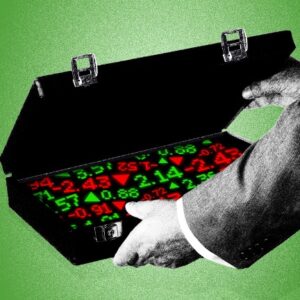
The Expanding Appeal of the “Buy, Borrow, and Die” Wealth Strategy
I moved into the much-loathed 1% tier of wealth seekers 15 or 20 years ago, but it was only two or three years ago that I learned about how some rich people avoid paying capital gains taxes on the assets in their portfolio: They borrow against the assets and repay those loans only after they die – a clever trick that takes advantage of a legitimate loophole. I never used the “buy, borrow, and die” strategy because I was in my giving-my-money-away phase of my wealth-building career when I discovered it and had already donated the majority of my assets to three nonprofits. (And yes, I got deductions for that.) But it is no longer just for the super-rich. As Margot Patrick explains in this WSJ article, Wall Street is beginning to offer the same trick to the lesser-rich.
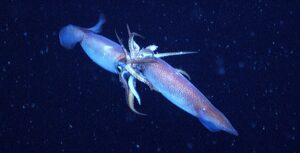
Two deep-sea squids mating
The Bizarre Ways Cephalopods Reproduce
In this comedic yet highly informative episode of his “True Facts” series on YouTube, Ze Frank explores the unusual ways different cephalopods procreate. In his usual forthright style, Frank examines the mating rituals of the cuttlefish, squid, and octopus, citing studies on how each group has its own unique manner of reproduction.
Worth Considering
Book Review: Bluebeard
By Kurt Vonnegut
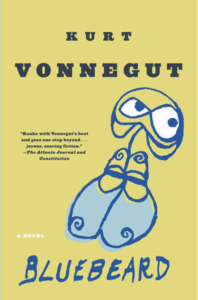
Original Publication Date: 1987
336 pages
Bluebeard is the made-up autobiography of Rabo Karabekian, a one-eyed, 71-year-old painter living alone in a large house on Long Island. He was a minor member of the Abstract Expressionist crowd – the Pollock and Rothko gang – and has ended up with a valuable collection of their paintings.
He wants to be left alone with his collection and his memories, and especially with whatever it is he keeps locked inside an enormous potato on his property. Then a pushy young widow named Circe Berman wanders onto his beach, moves into his house, and begins badgering him into writing the story of his life – the book we’re reading.
Bluebeard was the October selection for the Mules. I had no particular interest in reading it. I had the impression that I didn’t like Vonnegut’s writing. But when I saw a list of his books on Amazon, I realized that I hadn’t read any of them. And that I was mistaking him for Joseph Heller, the author of Catch 22, which I read 50 years ago and didn’t like.
So, Bluebeard was going to be a whole new read adventure. Into the book and the author, too. And it turned out to be a very good ride. I began Bluebeard thinking I was reading a clever, funny novel about an old painter looking back on an interesting life. By the end, I realized Vonnegut had been writing about something considerably larger: what an artist does with everything he has seen and cannot forget.
What I Liked About It
I liked – loved – that, at times, it felt like I was reading a transcript of my own thoughts. Vonnegut has a way of looking at serious subjects – art, ambition, war, love, success, failure – without ever reducing them to conclusions. He circles around them. He makes a joke. Then someone says something that changes the meaning of the joke.
I loved the storytelling, too. It reminded me a little of Lolita, although the books are obviously very different. Both tell large stories indirectly and unsentimentally. Bluebeard is the story of one man’s entire life, but behind that life is a considerable stretch of 20th-century history. Immigration, two World Wars, Abstract Expressionism, New York money, fame, and the strange transformation of paintings into extremely expensive objects. All of this is brought to life partly through action, but even more through conversation.
Nabokov did this superbly well. Hemingway did it, too. The usual rule is that writers should “show” rather than “tell.” But writers of this caliber can do something harder. They can show through dialogue. And Vonnegut does it constantly. Almost every conversation in this book is a little verbal jewelry box. You open it expecting one thing and find two or three others tucked underneath.
The literary device helps enormously. Rabo is trying to write the story of his past while his present life keeps barging in on him, usually in the form of Circe Berman. So the autobiography never feels like autobiography. It feels like life – the past being remembered while the present keeps interrupting. And it gives the book what I call horizontality. You move across decades and through different worlds and places, and you somehow feel like you understand them in a detailed and intimate way.
This was a big part of my enjoyment of the book. And although I pride myself on being able to understand the technology behind the fiction I read, in this case I wasn’t able to. It is a verbal form of prestidigitation.
Another thing I liked: the art. In particular, Vonnegut’s exploration of the emergence of abstract art prior to WWI, its development, and what it grew into after WWII as the art world moved towards “Post Modernism.” As he did with other elements of the history and culture of the time, Vonnegut does a great job of serving up the excitement and controversy of what happened to art (and to artists and dealers and collectors) during the first three quarters of the 20th century. He doesn’t give us answers to the important questions that those in the fine art community had to ask. He just gives us enough of the messy details of the questions to ward off any easy answers.
Great novels aren’t propaganda pieces with messages hidden inside them for clever readers to decode. They are works of art themselves. The best ones take you somewhere, slow you down, and let you see human beings through a lens that is more subtle and complicated than the one you normally use.
Bluebeard did that for me.
There were moments when I wondered whether Vonnegut might be flexing his literary muscles a bit more than he should have. For example, one of the things he does masterfully is to move away from the topic at hand to a seemingly unrelated but equally interesting subject before eventually returning to his departure points. This is clearly something he does intentionally. And for me, all of these diversions were great. But I can see how it could bother some readers.
Vonnegut also has a habit of following powerful, poignant, and painful moments with some sort of joke, and I can imagine how it might frustrate a reader that wanted to dwell in the seriousness of the moment. But again, for me, this wasn’t a problem. In fact, I loved that Vonnegut did that. The humor – especially when it was jokey-clever, like it usually was – made the moment that much more powerful for me.
Critical Reception
The critics mostly liked Bluebeard, although they tended to emphasize Vonnegut’s comic gifts more than what I thought was the deeper strength of the novel. The Atlanta Journal-Constitution said it “ranks with Vonnegut’s best” and called it “joyous, soaring fiction.” The Cincinnati Post praised the familiar Vonnegut arsenal: “satire, irony, ridicule, slapstick,” along with what it called a shaggy-dog story of epic proportions. But the observation I liked best came from The KansasCity Star, which said Vonnegut seemed “more fascinated and puzzled than angered” by the stupidities and contradictions he saw in human beings.
That gets very close to what I felt while reading the book. There isn’t much anger there. There is curiosity. And underneath the curiosity there is, surprisingly, quite a bit of tenderness.
Interesting
* Vonnegut was a prisoner of war in Dresden during World War II and survived the Allied firebombing of the city. That experience eventually produced Slaughterhouse-Five. It also hangs over Bluebeard, although for most of the book you don’t quite realize how heavily.
* The title comes from the old French fairy tale about Bluebeard, a wealthy man who forbids his new wife from opening one particular room in his castle – a literary device that Vonnegut turns around in several ways.
* The Rabo Karabekian character first appeared 14 years earlier in Breakfast of Champions, where he defended an abstract painting consisting of an orange stripe on a green field. In Bluebeard, Vonnegut gives what had been a relatively minor character an entire life.
* Vonnegut was also a visual artist. He drew throughout his life and later produced paintings and prints. So Rabo’s obsession with making pictures wasn’t simply research. Vonnegut knew something about it firsthand.
About the Author

Kurt Vonnegut (1922–2007) was born in Indianapolis and studied chemistry at Cornell before serving in the US Army during World War II. He was captured during the Battle of the Bulge and taken to Dresden, where he survived the Feb. 1945 bombing while being held underground in a meat-storage facility. After the war he worked, among other jobs, in public relations for General Electric before becoming a full-time writer. He eventually published 14 novels, including Cat’s Cradle, Breakfast of Champions, and his best-known book, Slaughterhouse-Five.
My Rating
Verticality: 4.5 out of 5.0
Horizontality: 4.5
Literary Richness: 5.0
Bonus: 0.5 – for the art world
Overall Score: 4.7 out of 5.0
Worth Considering
This weekend…
Masters of the Matrix: Latin American Printmaking
Presented by the Museum of Central American Art
Sunday, Nov. 15th at The Annex
290 SE 2nd Ave., Delray Beach, FL
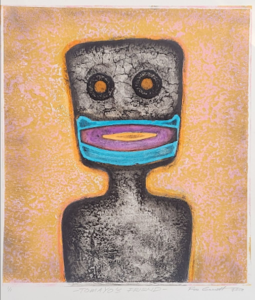
Ron Garrett, “Tamayo’s Friend,” 2019 multi-plate collagraph
Doors open at 2:00 p.m. At 2:30 p.m., join curator Suzanne Snider as she welcomes master printmaker, artist, and educator Ron Garrett, founder of Raga Press.
Garrett will bring a small etching press from his printmaking studio and demonstrate, step by step, how a hand-pulled intaglio fine-art print is produced. Visitors will have the opportunity to see the traditional printmaking process up close – from the prepared plate and application of ink to the printing process that transforms the image into an original work on paper.
RSVP suzanne@MoCAArt.org / 561-808-8587


