
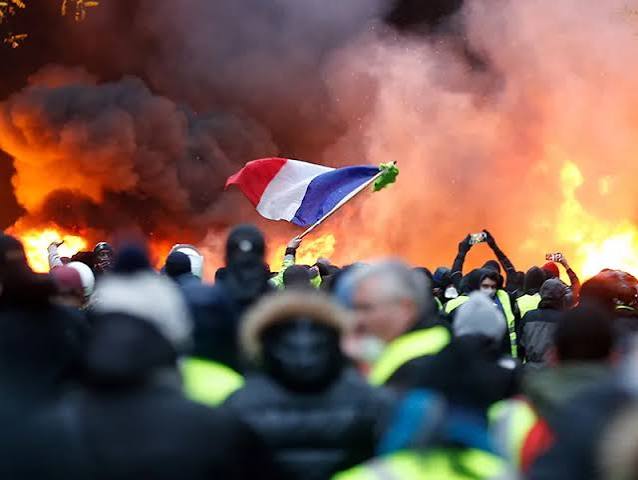
What the heck is going on in France?
According to Macron’s government and The New York Times, it’s been a few weeks of protest about underfunded high schools and the cost of living – most of it peaceful, with some regrettable violence around the edges. But according to about two dozen other sources that I’ve checked (most of which are firsthand accounts), it’s been a barely contained program of violence and destruction. And by insurance-company counts (always the most reliable data), it’s been the costliest man-made civil destruction in modern French history.
The size and scope of the damage merits consideration on its own. But the seeds of its development, the velocity of its unraveling, the way the French government and media politicized it – those facts are equally interesting. And particularly from an American perspective.
In so many ways, it’s been a reflection of what happened in the US after the death of George Floyd in 2020, including the “mostly peaceful” protests, the outbreaks of rioting and looting, the polarized response by both sides of the political divide and nearly all facets of the media, and the odd alliance of traditionally and logically incompatible activist groups – self-identified Socialists and Communists, Fascists that called themselves Antifascists, hibernating environmentalists, and radical Islamists, all of whom seemed urgently united in replacing the Enlightenment culture of the French Republic with a weird combination of post-modern nihilism, identity politics, contemporary queer and transgender ideology, and first-millennium religious doctrines and contemporary practices of Sharia law.
If it hadn’t already happened in the US just a few years earlier, I would not have been able to believe it. But it did happen. And it is still happening. So I think it’s impossible to consider it anything less than the most important social/political challenge of the last 50 years.
What Actually Happened
The trouble began, as these things often do in France, with students. But not college students. High schoolers.
In late September, students at high schools in Seine-Saint-Denis, a working-class suburb north of Paris, began blockading their schools to draw attention to an issue that is hard to believe they knew anything about, much less cared about: the effect of limited federal resources for the public school system, which was manifest in crowded classrooms, teacher shortages, and in some cases deteriorating buildings and – mon dieu! – sightings of rat droppings in the kitchens and cafeterias.
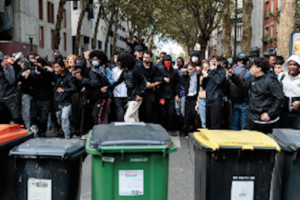
The protests were large. Shockingly large. More than 100,000 students involved in peaceful sit-downs, shutdowns, and organized marches that grew larger and more violent with each passing week. By early October, more than 6,000 people had been arrested, most of them teenagers.
The media had a field day publicizing the protests as an inspiring outburst of traditional French anti-government egalitarianism. And by Oct. 17, the students had been joined by labor unions, teachers, farmers, retirees, Yellow Vests, and assorted political groups. The Interior Ministry estimated that 550,000 people marched that day. The unions said 800,000.
As the media that was covering the protests reminded their readers and viewers, most of the events were “mostly” peaceful. But as we learned in the US during the BLM “mostly peaceful” protests, even small numbers of protesters can cause an enormous amount of chaos, violence, and destruction if they work assiduously and in common.
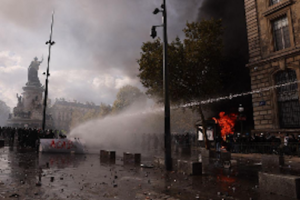
By the end of that weekend, about 2,400 people had been arrested across France, including 855 in the Paris region.
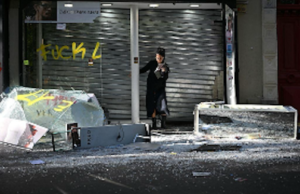
Looters smashed their way into stores. Cars and barricades burned. Public buildings were attacked. In Lyon, the tourist office was set on fire. And in Limoges, they burned City Hall. Not a trash can in front of City Hall. Not a police car parked beside City Hall. City Hall. The magnificent 19th-century building burned until much of its roof collapsed.
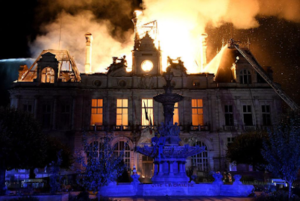
That photograph stopped me.
I’ve watched plenty of riots on television during my lifetime. Watts. Paris in 1968. Los Angeles in 1992. The French banlieues in 2005. The Yellow Vests. Minneapolis and the American riots of 2020. They usually have a recognizable shape. Something happens. A grievance catches fire. Crowds gather. Opportunists arrive. Windows get broken. Stores get looted. Eventually the police regain control and everyone argues about who was responsible.
There was some of that in France this month. But there was something else too.
What the Numbers Tell Us
I don’t love the tactic of using property damage as a proxy for social collapse. A burned building can be rebuilt. A broken political culture is harder to repair.
Still, Morningstar DBRS estimates that insured losses from the October riots could approach €1.2 billion. For comparison, the 2005 riots cost insurers about €200 million. The months-long Yellow Vest uprising cost about €220 million.
Thousands of businesses were damaged or looted. Some will never reopen. Others will raise prices or move. Insurance premiums will rise. Governments will spend more on policing. Shopkeepers will spend more on private security.
There is another bill to pay too.
French government debt was already in trouble before the riots. France’s 10-year bond yield has crossed 5% for the first time since 2002. I don’t want to make the mistake of saying the riots caused that. They didn’t. France entered October with enormous debt, weak growth, and a government that has repeatedly failed to get its finances under control.
The riots simply gave investors another reason to worry. And that may be more significant. I mean, really… markets don’t care about political rhetoric. They care about whether they are going to get their money back. And markets are beginning to charge France accordingly.
France has riots. This is hardly news.
If you have spent any time in France, and in Paris particularly, you know that the French practically invented political rioting as a recreational activity. When they aren’t blocking roads, they’re dumping manure in front of government buildings or setting something on fire.
When the participants were primarily indoctrinated college students with little to no experience in working for a living and no experience at all in contributing positively to the national GDP, I could view these stunts as something they would grow out of when they entered the phase of their lives when supporting themselves and their young families became their primary challenges.
This one became something different.
Students were in the streets. So were the unions. So were the Yellow Vests. So were organized groups from the radical left. And then came large numbers of people who apparently had little interest in education, public services, or political reform and a considerable interest in television sets, handbags, and anything else they could carry away.
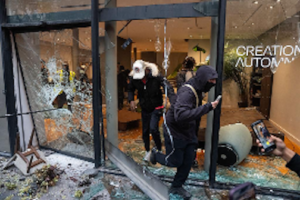
Political arguments tend to flatten everything. The left says “protesters,” as if a teacher carrying a sign and a masked man carrying a stolen television are engaged in the same activity. The right says “rioters,” as if the schoolteacher and the thief are the same person. But they aren’t.
And that gets us to the part of the story that makes people uncomfortable: Why were all these people in the same place at the same time?
A Strange Marriage Between Secular and Religious Interests
France has spent several decades developing two political movements that should, on paper, hate each other.
One is the radical left. It is secular, Socialist, feminist, pro-gay, and generally contemptuous of traditional religion. The other is radical Islamism, whose ideas about women, homosexuality, religion, and individual liberty would horrify almost every progressive I know.
Yet politically, portions of the two movements have discovered that they can cooperate. Why? Because they share an enemy: the existing Western order.
That doesn’t mean every Muslim in France is an Islamist. Obviously not. France has millions of Muslim citizens who work, raise families, pay taxes, and want exactly what everybody else wants: a decent life and a future for their children. Nor does it mean that Islamist organizations directed the October riots. I haven’t seen convincing evidence of that.
But what if there is a political convergence?
Jean-Luc Mélenchon’s France Unbowed party has built enormous support among French Muslims. (An IFOP survey found that 69% of Muslim voters supported Mélenchon in the first round of the 2022 presidential election.) That doesn’t prove conspiracy. It proves constituency. And constituencies create incentives.
Politicians defend groups that vote for them. Groups support politicians who defend them. Over time, alliances form between people who may disagree profoundly about almost everything else.
Politics has always worked that way. The dangerous part comes when the shared political interest becomes a shared belief that the society itself is illegitimate.
The Sticky Matter of French Culture
This is where I suspect I’ll get myself into trouble.
I used to believe that culture was mostly decoration. Food. Music. Clothes. Religion. Holidays. Language. Customs. But I’ve spent a good portion of my life traveling, working, and doing business outside the United States. And the more I have seen, the more I have come to believe that culture goes much deeper than that.
Culture tells people what work means. What family obligations mean. Whether education matters. Whether promises matter. Whether corruption is shameful or merely clever. Whether property belongs to the person who created it or to whoever is strong enough to take it. And, most important in this case, whether the laws and institutions of the country you live in deserve your loyalty.
This doesn’t mean cultures are fixed. Japan’s culture today isn’t the culture of Japan in 1600. American culture isn’t what it was in 1900. People adapt. Immigrants assimilate. Cultures borrow from one another constantly.
But assimilation requires something to assimilate to. And here France has put itself in a peculiar position.
For decades, much of the French intellectual class has been embarrassed by the idea of French cultural superiority – or sometimes even by the idea of French culture itself. Macron gave us a remarkable example during his first presidential campaign in 2017. “There is no French culture,” he said. “There is a culture in France, and it is diverse.”
Imagine saying that about the country of Molière, Voltaire, Hugo, Monet, Debussy, Rodin, and Camus. If the French aren’t willing to say there is something called French culture, why should newcomers feel obliged to become part of it?
That strikes me as the deeper issue.
And the Protesters Just Did It Again!
There was another large demonstration last weekend. And this time, France deployed 70,000 police.
The worst of the destruction did not repeat itself. There were still clashes and 1,314 arrests nationwide, but nothing approaching the mayhem of Oct. 17.
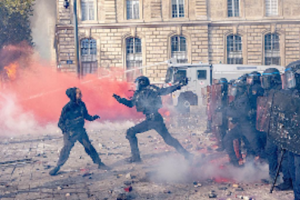
This could mean I am worrying too much. I hope so. Even though the unions and protest groups have called for more demonstrations and a national strike on Nov. 5, perhaps Oct. 17 will turn out to have been an unusually bad day – a huge legitimate protest hijacked by radicals and thieves. France will prosecute the criminals, negotiate with the students and unions, muddle through its fiscal difficulties, and go back to being France.
That is entirely possible. But I keep coming back to that photograph of Limoges’ City Hall. It reminds me that we had our own version of this in America in 2020.
And I can’t help but think that, today, we share some of France’s larger problems. We have an enormous national debt. We have entitlement programs that become politically almost impossible to reform. We have declining birth rates. We have political movements on both sides that increasingly regard the other side as illegitimate rather than merely wrong.
And – the one that concerns me most – we have become uncertain about our own culture.
George Floyd’s death could be outrageous, and burning somebody’s business could be outrageous. French schools can be underfunded, and burning Limoges’ City Hall can be insane. Police can use excessive force, and rioters can use excessive force. And a society gets into trouble when political loyalty requires pretending that only one of those things can be true.
Nigel Weighs In
I asked Nigel if he thought I had missed anything.
“The obvious thing, sir.”
“Which is?”
“France is still France.”
“Meaning?”
“It survived 1789. And 1830. And 1848. The Commune. Two World Wars. May 1968. The suburban riots. The Yellow Vests. French governments have been falling apart with considerable regularity for several centuries.”
“So I’m overreacting?”
“I didn’t say that.”
“You were thinking it.”
“I was thinking that history advises a little modesty.”
Fair enough.
“Anything else?”
“Yes. The evidence for an organized alliance between Islamist groups and the people who committed the violence is weaker than your original draft of this essay suggested.”
“I’ve fixed that.”
“You have.”
“And?”
“The majority of the hundreds of thousands of people who demonstrated were peaceful.”
“I said that.”
“You did.”
I waited.
“All right, Nigel. What’s bothering you?”
“The same thing that’s bothering you, sir.”
“Which is?”
“Limoges.”
Exactly.
Because I’ve come to think that the most important fact about these riots isn’t the number of cars burned, stores looted, or people arrested. It isn’t even who the rioters were. It’s the weakening of the bargain that makes a diverse democracy possible in the first place.
That bargain is surprisingly simple. You can be rich or poor. Christian, Muslim, Jewish, or atheist. You can hate the government. You can march against it. You can call the president an idiot. You can vote to throw everybody out. But there has to be something underneath all those disagreements that you won’t burn down. Some common idea of the country. Some shared belief that, however stupidly it is being run today, it belongs to all of us and is worth preserving for tomorrow.
France may still have plenty of that left. In fact, I’m sure it does. And America does too. The question raised by those flames in Limoges is how much.
And I don’t know the answer.
That’s what worries me.
Social Issues
Three Quick Bites
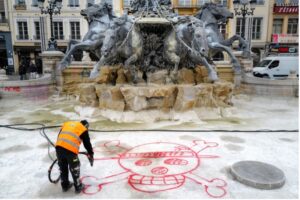
Lyon, France, Oct. 19
* “A Riot of Resentment in France”
* “How France Became the Poster Child for Debt Woes”
* “Why the French Riots May Be Coming to a Street Near You, and How You Can Stop It”
Worth Considering
Postscript: A Poem by Charles Simic

Charles Simic, widely recognized as one of the most visceral and unique poets of his generation
Back in 1972, when I was learning about modern poetry from Harriet Zinnes, a very good poet herself, I became a fan of Charles Simic primary because she spoke highly of him and his work. This is the first poem I’ve read of his since then, and I’m trying to figure out if I like it. I don’t NOT like it… and I do like the image of that little ant struggling against the enormousness of its universe. But I can’t grok that last line. Can you explain it to me?
October Arriving
I only have a measly ant
To think with today.
Others have pictures of saints,
Others have clouds in the sky.
The winter might be at the door,
For he’s all alone
And in a hurry to hide.
Nevertheless, unable to decide
He retraces his steps
Several times and finds himself
On a huge blank wall
That has no window.
Dark masses of trees
Cast their mazes before him,
Only to erase them next
With a sly, sea-surging sound.


