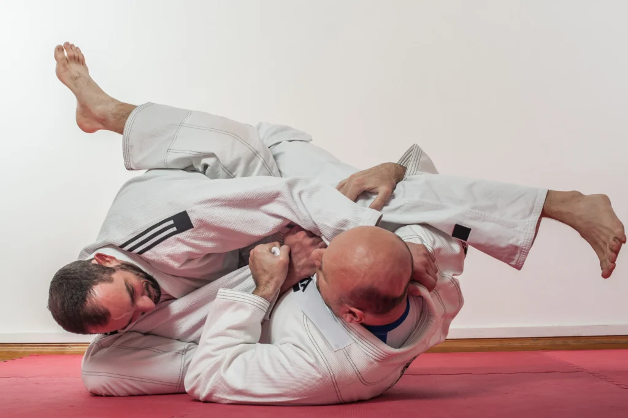
One of the things you learn in Jiu Jitsu (and you can learn just everything that is worth learning in Jiu Jitsu) is that when your opponent is holding you down and pressing his weight against your face, aiming to suffocate you, the worst thing you can do is struggle to remove him.
Such efforts would be ineffective against even a middle-level Jiu Jitsu practitioner, and the struggling would rob you of what little breath you have and make your defeat all but inevitable.
The proper response is to remain – for the moment, at least – passive. You slow your breathing while you make small, almost imperceptible, movements to turn your head to the side so you have a passage of air to breathe. Then you make slow and smooth adjustments to your body, depending on how his body is positioned, until you are in a position to reverse him.
When the reversal comes, it comes at full speed and strength. Not a prolonged struggle. A single action, taken with confidence. He experiences a sudden and unexpected feeling of surprise, followed by an equally sudden and unexpected feeling of defeat, followed by longer moments (possibly lasting months) of wondering how you had extricated yourself from an embarrassingly subordinate position so effortlessly.
You, of course, know how you did it because you had practiced the components at least a thousand times.
Give It 110%
As a 30-year practitioner of Jiu Jitsu, I sometimes think about the difference between the way I think about sports today compared to my approach when I was playing sports in high school. Whether the game was football, basketball, or wrestling, the formula for wining was maximum strength, maximum speed, and always 110% effort.
There is a time in your life when outworking, out-aggressing, and outlasting the competition will serve you well. It won’t always put you at the apex of the victory podium, but it can very well keep you in contention.
That was certainly my approach early in my business career. It worked to get me started and it continued to work whenever everything else failed. But it didn’t take me long to realize that working at that pace and intensity is not a realistic lifetime strategy for success.
If you watch a high school football or basketball game, you may very well see that the winning team claimed victory by giving the game the 110% their coaches asked for. But you won’t see that in the NFL or the NBA. At that level, brute energetic force is only a small part of what it takes.
I used to have front row tickets to the Miami Heat basketball games. And I remember watching Michael Jordan, one of the greatest basketball players of all time. Find an old game on YouTube and pay attention to how he moves on the court. Most of the time, he’s so relaxed and even gentle in his movements that he’s almost boring. Then, all of a sudden, he makes a quick (and usually aesthetically beautiful) move and a basket is scored. Or a block. Or a three-pointer.
Grappling Blindfolded
I got a lesson in what was going on in his head by training in Jiu Jitsu blindfolded.
Take away your eyes and all you have left is feel. And you discover very quickly that you can battle, control, and defeat an opponent much better when you take the time to sense exactly where his center of gravity is. You learn to feel when he’s under-committed – holding back, not quite sure. And you learn to feel when he’s overcommitted – leaning too far, pushing too hard, reaching for something he can’t hold. That’s the moment to move.
Here’s the thing: You can’t feel any of that when you’re tense. Tight muscles don’t send information. They send noise. The struggler on the bottom isn’t just wasting his breath. He’s deaf to the signals.
The same principle applies to ballroom dancing.
Thirty years ago, I took lessons with K. I’ve never been a natural dancer, but what made things worse is that, after two tequilas, I thought I was one. That left me with a dancing style that was potentially life threatening for K – aggressively making my moves and using my size and strength to throw her around like a rag doll.
But as our instructor patiently explained to me, dancing is more than merely being energetic. Most of it, he said, lies in subtle movements that are barely noticeable. It’s about the time it takes to get a mutual rhythm going and the additional time it takes to develop an awareness of how your partner is dancing. For the lead dancer (usually the man), it’s about being keenly aware of her weight distribution, her body position, even which foot she has her weight on at every moment.
That is very similar to what grappling with a blindfold on forces you to do.
Pareto Squared
In recent months, I’ve been developing an idea that I call “Pareto Squared.”
I’m sure you have heard of the Pareto Principal or 80/20 rule. It states that about 20% of your efforts produce about 80% of your results. That rule has an astonishing record of working in economics, politics, business management, wealth building… you name it.
My idea is a simple knock-off of that: We take the rule one step further – to 20% of 20% – and we end up with 4%. However interesting Pareto’s Law is, squaring it brings us to an even more interesting place. It means that a mere 4% of the input of any human endeavor produces about 96% of the results.
So far, based only on my own experience, it looks like the 4/96 rule holds up remarkably well. But I’d like you to test it against your own experience.
Here’s the hypothesis: In almost any challenging situation, you should be using real force, decisive and committed, about 4% of the time. The other 96% should go to staying relaxed and paying attention. Feeling where the other person’s weight is. Noticing when he’s leaning too far or holding back. Watching how he reacts to what you do, and managing those reactions with as little stress as possible for everyone involved.
Then, when the 4% moment comes, you’ll be able to recognize it – and take advantage of it.
Conquer, Then Release
In Zaire, in October 1974, Muhammad Ali fought George Foreman for the heavyweight title. Foreman was younger, stronger, and the overwhelming favorite. He had demolished nearly everyone he’d faced. Ali spent round after round leaning on the ropes, covering up, letting Foreman pound away. It looked like surrender – like the Jiu Jitsu player on the bottom, breathing through the side of his mouth. But by the eighth round, Foreman had punched himself out, and Ali knocked him down with a short, quick combination. The 4% moment.
We have a saying in Jiu Jitsu: Strength is defeated by technique, speed is overcome by timing, and relentlessness is defeated by knowing when and how to relax. Ali had all three. But it was the third one that won the fight.
Strength, technique, speed, timing… it made me think about Olympic figure skaters. During an entire routine, I wondered, how much time does a skater actually spend on the big jumps – the triples and quads everyone remembers? Could it be anything like 4%?
I asked Nigel to work it out.
A senior free skate runs four minutes, sir, and the rules permit up to seven jumping elements, some of them combinations – call it 10 jumps for a skater at the top of the sport. Each jump keeps the skater airborne for perhaps two-thirds of a second. That comes to six or seven seconds aloft out of 240, or roughly 3%. Count the takeoff and the landing as well and one arrives at perhaps 5% or 6%. I should stress that these are my own estimates rather than measured figures. I would also note that the jumps account for a large share of the technical score.
So there it is: about 4% of the routine, and a big chunk of the points. But the other 96% isn’t filler. The gliding, the edges, the crossovers – that’s where the skater builds speed, sets the angle, and finds the timing. A skater who comes into a jump tense or off balance ends up on the ice. The jump gets the applause. The setup is what makes it possible.
If my hypothesis is right, it changes how you should learn any complicated skill, including business skills. Most people put emphasis on the 4%, making the big move. But most of the learning belongs in the 96%.
Practice paying attention. Rehearse the situations that make you tense until they don’t. Do enough deals, roll with enough partners, have enough difficult conversations… and knowing when and how to relax before making that explosive move takes care of itself.
Worth Considering
Three Quick Bites

Pavel Prigozhin in an undated photo
“The Playboy Who Inherited the World’s Most Notorious Mercenary Force”
The son of Wagner Group’s late founder hangs on to an African stronghold, making a fortune from guns, drugs, and gold. Read more here.

Women: Before you even think about becoming a Muslim…
Tailortati, an outspoken Israeli Zionist that blogs regularly on Islamicism, shares some of the benefits of Allah’s “ordinances” (commandments) to men on what they can do with women that convert into Islam.

War Pigs!
I was never a big fan of this Black Sabbath song, but Cybertronic Spree – a Toronto-based cover band that performs in full Transformers costumes – does a good job of making it come to life.
Worth Considering
Movie Review: Richard Jewell

Directed by Clint Eastwood
Starring: Paul Walter Hauser, Sam Rockwell, Kathy Bates, Jon Hamm, and Olivia Wilde
Run Time: 2 hours, 11 minutes
Released: Dec. 2019
K has agreed to a weekly movie night. My job is to select the movie, which I do with a keen eye on her reactions when I show her the three or four trailers I’ve nominated. (Pretty much the same way I select my clothes when we are going out.)
I was surprised she went for this one – not only because it’s sort of dark and possibly depressing, but because it’s political (although I couldn’t tell from the trailer which way it was tilting).
The Story
Atlanta, 1996. Richard Jewell is an overweight, overly earnest security guard who lives with his mother and dreams of wearing a badge. During the Summer Olympics, he spots an unattended backpack at a concert in Centennial Olympic Park. It holds a pipe bomb. He helps clear the area before it explodes, and overnight he’s a hero. Within days, the FBI decides he fits the profile of a lonely wannabe cop who plants a bomb so he can be the one to find it. Someone leaks his name to a reporter at the Atlanta Journal-Constitution, and the hero becomes the suspect. With help from a scruffy lawyer he once worked for, Jewell fights to get his name back.
What I Liked About It
The screenplay was tight and dramatic. The action and pacing were well done. I was continually engaged in a kind of crescendo of interest and suspense. Kudos to Clint Eastwood and Joel Cox (the editor) for that.
The sound and lighting were well done, too. They always contribute a great deal to the emotional power of the story, and when I don’t notice them, which was the case here, I give the movie extra credit for that.
The acting was strong – particularly the acting of the lead, Paul Walter Hauser, whom I’d never seen before. (He looked like he was selected because he actually resembles Richard Jewell.)
But most of all, I was taken by the story – the fact that the movie was based on a true story. A story of government power and abuse that, while not surprising, re-engaged my strongest feelings about the danger of politicians, policemen, and the press.
What I Didn’t Like So Much
Very little.
I was a bit undecided about the acting of Jon Hamm, who played the principal FBI agent on the case. His character seemed a little too slick and polished for my taste. I’m not sure if it was because of how Hamm was directed, or how he interpreted the role, or the fact that I think of his character in Mad Men whenever I see him.
Interesting
* The source. The film is based on Marie Brenner’s 1997 Vanity Fair article “American Nightmare: The Ballad of Richard Jewell” and on The Suspect, a 2019 book by Kent Alexander and Kevin Salwen.
* The casting that almost was. The project was announced in 2014 with Jonah Hill as Jewell and Leonardo DiCaprio as his lawyer. Paul Greengrass was attached to direct for a while. Eastwood took over in early 2019, and Hill and DiCaprio stayed on as producers.
* The real bomber. It was Eric Rudolph, an anti-government extremist who went on to bomb abortion clinics and a lesbian nightclub. He was caught in 2003, pleaded guilty in 2005, and is currently serving multiple life sentences without the possibility of parole.
* What happened to Jewell. He was publicly cleared after about three months. NBC, the New York Post, and others settled his libel suits against them, but the Journal-Constitution fought for more than a decade and won. Jewell died in 2007 at 44.
Critical Reception
Warner Bros. spent $45 million making Richard Jewell, and it took in about $22.3 million in the US and roughly $44 million worldwide. That just about paid for the production, but not for the marketing, and the trade press called it a flop.
It scored 77% with critics on Rotten Tomatoes (about 300 reviews) and 96% with audiences. (That gap of nearly 20 points tells you something.) Metacritic put it at 68, “generally favorable.”
At RogerEbert.com, Glenn Kenny praised the performances, especially Paul Walter Hauser, Sam Rockwell (as the attorney), and Kathy Bates (as the reporter), who he thought stole the picture. He noted that Eastwood doesn’t do moral relativism: The FBI agent and the reporter are villains, and the movie doesn’t apologize for it. His bottom line was that Eastwood holds the trump card, because whatever you think of the film, what happened to Jewell happened.
Variety thought Eastwood told a good story well but warned that the movie is no more accurate than the people it criticizes. Den of Geek called it Eastwood’s best in years. The San Francisco Chronicle gave it a perfect score for its lean, no-flourish storytelling.
The dissent focused almost entirely on one thing: the negative portrayal of the real Journal-Constitution reporter Kathy Scruggs, who is shown offering sex to the FBI agent in exchange for the tip. The Associated Press’s Jake Coyle called the film thought-provoking, but said that in smearing Scruggs it commits the same injustice it condemns.
My Rating: 8.5 out of 10
Overall, very good. A plot that fully engages. Characters who are believable and true. Craft that adds to the experience of watching it instead of apologizing for it. Most importantly, the movie left me thinking and rethinking ideas I’ve had about the subject matter for weeks afterwards.
Worth Considering
Postscript: Easy or impossible?
I’m working on this. Not quite there yet…