
Accomplishing a goal has three phases: deciding to do it, determining what specific actions are necessary and in what order, and executing those actions.
Ah, there’s the rub. Out of every 100 people who choose to do something, about 80 will give up before they begin because they don’t have an effective plan. Of the 20 that remain, 16 will fail simply because they stop.
So how can you increase the likelihood that you will be one of the few who finally succeed? You need to begin with a realistic idea of how long your goal will take to accomplish.
I started to think about this when I began learning Jiu Jitsu and I wanted to know how long it would take before I would be “good” at it. At the same time, I was helping friends and relatives with career choices and wanted to be able to tell them how long it would take them to achieve proficiency in the specific skills they would need.
The Numbers
For any complex skill, there are basically three levels of achievement: competence, mastery, and virtuosity.
Take ballroom dancing. You probably know people who are competent on the dance floor. Whether it’s a cha-cha, a fox trot, or a swing number, they can make the moves. The next level, mastery, is the level of the professional dancer: a teacher or a member of a dance troupe. Virtuosity? That’s Fred Astaire.
When I decided to write about this for Early to Rise, I talked to friends and colleagues to see if their experiences corresponded with mine. I talked to my brother AF about how long it took him to become competent in, and then a master of, Greek and Roman literature. I talked to my colleague JA about how long it took him to go from a Class C chess player to a rating above 2,000. I talked to AS about how long it took him to improve from showing card tricks at parties to headlining as a magician in clubs. I talked to my French horn teacher about how long he estimated it took his new students to go from incompetent to competent. I talked to a half-dozen friends who were world-champion martial artists, as well as dozens of people I considered master marketers, copywriters, and investment analysts in my industry.
The numbers weren’t precisely equal, but the overall impression I got made me feel confident enough to publish my theory way back then.
Here is how I expressed it at the time:
* It takes about 1,000 hours to become competent at any complex skill.
* It takes about 5,000 hours to master it.
* It takes between 25,000 and 35,000 hours to become world-class – and that’s assuming you were lucky enough to be born with a “gift.”
An Example: Learning a Foreign Language
I am not talking about the hours you might spend with a language CD playing in the car or sitting in the back of a classroom letting a lecture wash over you or “practicing” the guitar while you watch television.
The hours that count are the hours of focused, intentional effort – deliberate learning. You are paying full attention. You are working at the edge of what you can do. You are noticing your mistakes and correcting them. You are aware of exactly what your body or your mind is doing.
Based on my own experience, this is what it would take to become a competent speaker of French:
* 300 hours to learn – cold – the 20 most common irregular verbs in three tenses
* 100 hours to master about 50 prepositions, conjunctions, and articles
* 200 hours to get a good grasp of French grammar
* 200 hours to learn about 1,000 useful nouns
* 100 hours to memorize gender
* 50 hours to acquire passable pronunciation
What does it add up to? 950 hours!
At that point, you could speak French “well” – but to master the language, you’d have to put in a lot more time. Say you studied two hours a day and practiced for another three, and you did that for three years. You would have reached a level that most people would consider fluent – and you’d have logged something close to 5,000 hours doing it.
The Coaching Discount
After three years and about 700 to 800 hours of instruction and practice in Jiu Jitsu, I could easily handle newcomers, even those bigger, stronger, and more athletic than I was. But I struggled against more experienced players.
Seven hundred hours is not 1,000. But in my case, I had the advantage of being trained by an excellent coach, and that counts for a lot. So I made this adjustment to my theory: Based on my experience, you can deduct as much as 40% off the time required to achieve competence if you have a good teacher.
That same “discount” applies to having an expert mentor. Someone who has traveled the same road you’re on. Someone who can show you the way and stop you the instant you drift from it.
The single most valuable thing these people can give you is not encouragement. It is correction – early, precise, and relentless.
The Jazz Master’s Secret
Aristotle taught that art begins in imitation. He had a word for it: mimesis. The best way to learn an art, he believed, is to imitate great art.
Howard Roberts, the legendary jazz-guitar virtuoso, took that thought one step further. He said that the way to become great at any skill is not just to repeat it, but to repeat it without error.
That is a very powerful combination. Imitate the movements of the masters. Repeat their movements over and over again. And repeat them exactly.
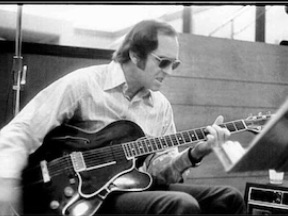
Howard Roberts
Roberts’ theory was that any learning is the biological process of creating neural networks in the brain. Every perfect repetition beats a path – one you can travel on later. Every incorrect repetition beats a parallel but incorrect path – one you can easily slide onto if you aren’t careful.
The more you practice the right moves, the deeper the memory path. The trick is to make the correct paths as deep as possible and the incorrect paths shallow or nonexistent.
The faster you eventually perform a task, the more likely you are to make a mistake – unless you have cut only one path for it, a perfect one. Likewise, when you perform a task under stress or in combination with other tasks, it’s easy to bungle unless you have no neurological way to screw it up.
The trouble with most guitar students, Roberts said, is that they’re in a hurry. They are fixated on completing a movement rather than on performing it well. They figure the sooner they can simulate the finished movement, the better they’re doing. The truth is the opposite.
I still make that same mistake with Jiu Jitsu. When I learn a new move, I want to master it quickly. Instead of taking each part slowly and surely, I rush – and I learn an imperfect movement.
My instructor, a great Jiu Jitsu player, has been telling me to slow down for as long as he’s known me. Now I understand why.
The Fundamental Rule
The “10,000-hour rule,” popularized by Malcolm Gladwell in Outliers, is based on the idea that it takes a total of roughly 10,000 hours of dedicated effort to get from incompetence to mastery in anything. My concept breaks the journey down to two stages: from incompetence to competence (1,000 hours), and then from competence to mastery (5,000 hours).
But my total comes to 6,000 hours – a good deal shy of Gladwell’s 10,000. So is one of us wrong?
Here’s the thing that Gladwell’s number left out: the coaching/mentoring discount. Take his 10,000 hours, knock off that 40%, and what do you get? 6,000 hours.
Same mountain. He was just measuring the long way up, without the shortcuts.
Getting Started Is the Hardest Part

There’s one more level that can be reached: going from masterful to world class. But unlike competence and mastery, this level requires that you start with a substantial amount of innate talent – and I’ve estimated that, even if you are “gifted,” it would take another 25,000 to 35,000 hours of practice.
That number, I have to admit, did not come from any serious research. But I didn’t extract it, as they say, entirely from my arse. I spent a few hours trying to tabulate how many hours I thought it had taken Michael Jordan and Bobby Fischer to get to the very top of their fields, and that’s what I came up with. Okay, maybe it did come from my arse. That’s not the point.
The point is this: If you have a desire to become good at any complex skill, it’s going to take a lot of time and a lot of hard work. Which is the reason most people never even start.
But the good news is that, after those first 1,000 hours of humiliating drudgery – once you have achieved that first level of competence – the rest of your rise to greatness will be easy. And because doing anything you’re good at is enjoyable, it will even be fun!