

I came back to Tokyo this week after being away for almost exactly a year. A year isn’t very long for a city that has been around for four centuries, so I wasn’t expecting to see much that was new. But I did.
Some of the changes are small. But several are enormous.
The Seoul I remembered from my first trip there was much “older” than the Seoul I encountered on this trip, and that Seoul had both similarities and differences with Tokyo that I couldn’t ignore.
Both cities are huge, prosperous, clean, safe, and extraordinarily well organized. Both have forests of skyscrapers, excellent public transportation, beautiful parks, expensive shops and restaurants, and all the conveniences you expect from a rich, modern Asian city.
But Seoul looked newer. My first guess was that Tokyo looked perhaps 30 years older. Which, historically, makes some sense. Japan’s great postwar economic expansion began earlier. By the time I first visited Tokyo in the mid-1980s, it already looked like the city of the future. Seoul’s spectacular transformation came later.
But walking around Tokyo this week, I’m beginning to think that comparison misses something.
Tokyo is getting another facelift. The most dramatic example is Takanawa Gateway City, a huge new development built largely on former railway land south of central Tokyo. Parts of it were operating when I was here last year, but the entire district officially opened this March.
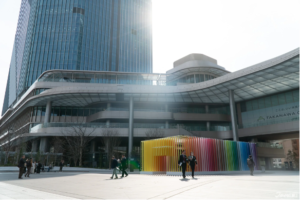
Takanawa Gateway City
And “district” is the right word. This isn’t a building or a shopping center. It is nearly a mile-long attempt to create a small city within the city. Offices, residences, hotels, shops, restaurants, parks, and cultural spaces, all connected to one of Tokyo’s newest train stations.
There’s even a new museum, MoN Takanawa, the Museum of Narratives. A little farther south, another new mini-city has appeared around Oimachi Station. Oimachi Tracks, also opened this year, combines offices, residences, restaurants, a hotel, a cinema, wellness facilities, and public space. These developments are interesting because they suggest that Tokyo isn’t simply replacing old buildings with taller new ones. It is reconsidering how people live inside a very dense city.
And then there is the opposite kind of reinvention.
The Edo-Tokyo Museum reopened this year after being closed for four years. I want to see it because its subject is exactly the question I’ve been thinking about since arriving here: How does a city this old keep becoming new?
Tokyo has had more practice at this than almost any city in the world. Much of it was destroyed by the Great Kanto earthquake and fire in 1923. Huge sections were destroyed again by American bombing during World War II. Then came the extraordinary postwar reconstruction, followed by the economic boom that produced much of the Tokyo I first saw 40 years ago.
Now another generation of rebuilding is underway.
Akasaka has a major new development, including the new 1 Hotel Tokyo. The Park Hyatt in Shinjuku – the hotel made famous by Lost in Translation – has reopened after a 19-month renovation. Out in Ariake, a giant new entertainment complex called Tokyo Dream Park opened this year.

Tokyo Dream Park
There is another change that has nothing to do with buildings. There are more foreigners.
Japan has been breaking tourism records, and Tokyo is absorbing a large share of them. In Ginza, Shibuya, and Asakusa, you sometimes hear almost as much English, Chinese, and Korean as Japanese. The influx has become large enough that Japan raised its departure tax this summer, partly to pay for the costs associated with all those visitors.
I’m not yet sure what I think about that. Tokyo has always been unusually good at absorbing outside influences without ceasing to feel Japanese. McDonald’s somehow becomes Japanese in Tokyo. So does jazz. So does French pastry. So, for that matter, does Christmas.
Can Tokyo absorb tens of millions of foreign visitors with the same confidence?
I don’t know. But after a week here, I’m reconsidering my first comparison with Seoul.
Seoul still looks newer to me. I think that impression was real. But perhaps I was confusing “newer” with “more modern.” Tokyo’s modernity has layers. You can walk from a neighborhood that looks essentially as it did when I first came here in the 1980s, take a 10-minute train ride, and emerge into something that looks as if it was designed for 2040. And somehow both places still feel unmistakably like Tokyo.
That may be the more interesting difference between these two extraordinary cities. Seoul looks like a city that has recently become new. Tokyo looks like a city that has learned how to become new over and over again.
Investing
Why I Stopped Buying Art at Auction
It Took Me Years to Discover How Much My “Bargains” Were Really Costing Me

A view of the galleries in Bonhams new 57th Street headquarters
In early September, ARTnews reported that Christie’s and Bonhams had quietly raised the fees they charge buyers. Christie’s now adds 28% to the hammer price of anything selling for up to $2 million, the same rate Sotheby’s began charging in February. Bonhams, as of this month, adds 30% to the first $35,000.
I read that and felt a familiar irritation. I first felt it about 30 years ago, when I figured out something about auction houses that I should have known long before. It was hardly a secret. Every dealer in the business knew it.
Why Were They Applauding?
My first serious auction purchase was a first edition of Huckleberry Finn, back in the mid-1980s. It wasn’t just any first edition. It was one of the scarce leatherbound copies (the publisher issued only a few thousand in leather, against some 20,000 in cloth), and I paid a lot of money for it. Something like $30,000, if memory serves. When the gavel came down, the room broke into applause. I remember feeling pleased with myself, and then wondering whether they were clapping because I’d gotten a good deal or because I’d paid too much.
I didn’t study the bill. Had I done so, I’d have seen a 10% buyer’s premium added to the hammer price. Sotheby’s and Christie’s had been charging it since the mid-1970s.
I knew, in a general way, that the auction house took a cut. I assumed it was a single fee, paid by one side or the other, and probably somewhere between 10% and 15%. That seemed a reasonable price for bringing a buyer and a seller together, and I didn’t give it another thought for years.
My Brilliant Little Plan for Buying Art Cheap
I got into the art business in the early 1990s, first dabbling during my first (short-lived) retirement, then opening Morgan Fitzgerald Fine Art in about 1993 and, in the early 2000s, Ford Fine Art with Suzanne Snider. For the first 10 years or so, most of what I sold was art I had collected over the years. I did some buying at auction. I did no selling there.
My plan for growing the collection was simple. If I could buy good pieces at auction for less than they were worth, every purchase would add to the collection’s net worth the day I brought it home. Later, I could sell at full value. Auctions seemed like the obvious hunting ground. Where else would I find motivated sellers and no retail markup?
So I bid on things like a small Vuillard at $75,000 and a Picasso pencil drawing at $40,000, and I felt clever when I won.
The idea was sound enough. What sank it were two things I didn’t understand about how auctions actually work.
What the People I Was Bidding Against Knew That I Didn’t
The first was the fee, or rather the fees. The buyer pays a premium on top of the hammer price. The seller pays a commission out of it. The auction house collects both.
By the early 1990s, the buyer’s premium at Sotheby’s and Christie’s had risen to 15% on the first $50,000 and 10% above that. Seller’s commissions varied and could be negotiated, but on a modest consignment 10% was typical. So when that $40,000 Picasso drawing sold, the house collected $6,000 from the buyer and $4,000 from the seller. That’s $10,000, or 25% of the hammer price, for one transaction.
In my case, since I wasn’t reselling at auction, the seller’s commission never touched me. The premium did. If I managed to buy a drawing 15% below what I thought it was worth, the premium handed the entire discount back to the auction house before I’d hung the thing on a wall. My “bargain” had cost me exactly what the piece was worth, plus shipping, insurance, and framing.
In fact, by the time you added the premium, the total price at auction was often no better than what a good dealer would have taken for a comparable piece after a bit of haggling. Sometimes it was worse. I’d been avoiding the retail markup by paying a different one.
Your Break-even Point, Then and Now
Suppose you buy a drawing at $40,000 hammer price and later sell it at auction, paying a 10% seller’s commission…
Early 1990s (15% buyer’s premium):
You pay $46,000. To get that back, the drawing must hammer at about $51,100. Required appreciation? Almost 28%. The house collects 25% of the original hammer price.
Today (28% buyer’s premium):
You pay $51,200. To get that back, the drawing must hammer at about $56,900. Required appreciation? About 42%. The house collects $15,200, or 38% of the hammer price
The second thing I misunderstood was the competition.
At any serious sale there are dealers in the room or on the phone who know exactly what a piece should bring and what they can resell it for. When something good starts going cheap, one of them raises a paddle. They aren’t doing it to be kind. It’s how they make their living, and their bidding puts a floor under prices. The floor isn’t perfect, but it’s real.
What that meant for me was sobering. The bargains I was hoping to find were mostly being found by people who did this every day. When a piece did sell well below its estimate, it was usually because the professionals had looked at it and passed, whether for condition, a doubtful attribution, or because everyone in the trade had already seen and rejected it. The discount was telling me something, and I wasn’t listening.
It took me longer to arrive at a worse thought. On the occasions when I won a piece, I had won it by being willing to pay more than every professional in the room. Economists call this the winner’s curse. I didn’t know the term then, but I began to feel it.
After that, the big auction houses looked to me like a place where amateurs go to make money for the dealers and the auction houses. That’s harsh, and I know it isn’t entirely fair. Auctions do some things very well. Prices are public. Sellers get real competition, and an important work with two or three determined bidders can bring a price no private negotiation would. Executors and estates need that kind of transparency. And the houses do real work (research, authentication, cataloguing, marketing) that costs money. But for someone trying to build a collection by buying below value, the auction room was the wrong place to shop.
Where I Started Finding the Real Bargains
So I stopped buying at auction and started buying from private owners. Collectors who were downsizing, heirs who didn’t want what they’d inherited, and people who needed money and didn’t want to wait months for a sale and then give up a quarter of the proceeds to get it. With no auction house between us, there were no fees on either side. More than once, a private seller let me have a piece at a price I could never have gotten at auction.
Buying privately has its own costs. There’s no catalogue, no specialist, and no one to complain to afterward, so you’d better know what you’re looking at. That was a separate education, and another story.
Which brings me back to that ARTnews piece. When I bought my Huck Finn, the buyer’s premium was 10%. Today, it’s 28%. The auction houses have gotten better at almost everything over the past 40 years, and that includes getting paid.
I still don’t know for certain why that room applauded – but I have a better guess than I did then, and I don’t think they were clapping for me.
Note: When I finished writing this little essay, I asked Nigel to look it over and tell me whether I had misremembered any of the facts, particularly the numbers. You might be interested in what he said:
Your memory is surprisingly good, sir.
In the mid-1980s, when you bought Huckleberry Finn, Sotheby’s and Christie’s were charging buyers a 10% premium on the hammer price. Christie’s introduced it in 1975, and Sotheby’s followed almost immediately.
By 1993, both houses had raised the buyer’s premium to 15% on the first $50,000, with 10% above that. Seller’s commissions were more complicated. Before 1995 they were negotiable, and for important consignors they were sometimes waived entirely. For a modest consignment, though, 10% was a reasonable figure.
I would make one small correction, sir. The 25% the house collected on a sale like your Picasso drawing was not its profit. It was its gross revenue from the transaction. Sotheby’s and Christie’s did have expenses, although I appreciate that this distinction may not greatly reduce your irritation.
Your prices are plausible as well. By the 1990s, a small Vuillard could sell in the tens of thousands, while major canvases brought far more. A Picasso drawing could range from tens of thousands to several hundred thousand dollars, depending on the sheet. So $75,000 and $40,000 are reasonable examples, not anomalies.
As for the Huckleberry Finn, most of the roughly 23,000 copies of the first American edition were bound in ordinary cloth, and those sold for a fraction of what you paid. A leatherbound copy was another matter. For a book that scarce, $30,000 was a defensible price, though I can’t promise it was a bargain.
There is also an interesting postscript. In 1995, Christie’s and then Sotheby’s announced new, nonnegotiable seller’s commissions on almost identical sliding scales, from 10% on smaller lots down to 2% on lots above $5 million. It later emerged that senior executives of the two houses had agreed on those rates privately. The scandal produced criminal prosecutions, including a jail sentence for Sotheby’s chairman, and a civil settlement of $512 million split between the two houses. So a collector who consigned a modest work to either house in the late 1990s and paid 10% was paying, quite literally, a fixed price.
So yes, sir. Your recollection that buying and selling through the major auction houses was an expensive business is well supported by the historical record. If anything, you may have had more reason to be annoyed than you remember.
Worth Considering
Three Quick Bites

Smithsonian Institution Secretary Lonnie G. Bunch III
“Privatize the Smithsonian”
To keep its independence, says Eric Gibson in this WSJ op-ed, the nation’s attic needs to get off the government dole.

How Twinkies Became a $5 Billion Problem
This is a classic example of what happens when you buy (or invest in) a business about which you have only exterior knowledge.

The Invention of “Rubbish” Data
Real-world data did not show droughts around the world getting worse because of global warming. That was not the kind of news the political left wanted out in public, so they hired scientists to invent a measure that does.
Worth Considering
This weekend…
Masters of the Matrix: Latin American Printmaking
Presented by The Museum of Central American Art
Sunday, Oct. 18th, at The Annex
290 SE 2nd Ave., Delray Beach, FL

Sergio Hernandez, “Serie de la Conquista” (“Series of the Conquest”), serigraph
Doors open at 2:00 p.m. At 2:30 p.m., join curator Suzanne Snider for an informative talk and guided tour of our latest exhibit.
Discover the complex, unique, and sophisticated techniques that master artists use to create original multiples. Learn how to spot the differences, appreciate the true craftsmanship, and see why limited artist’s editions are the most rewarding – and affordable – way to start, build, or enhance your own art collection.
RSVP suzanne@MoCAArt.org / 561-808-8587


