
A few more impressions of Seoul, after several more days of walking and driving around the city…
* Koreans are noticeably more outgoing than the Japanese. They smile more readily. They approach you. And they touch you.
I don’t mean anything intimate. A Korean I’ve just met will put his hand on my arm or shoulder while talking to me. It is a small gesture of friendliness, and after spending considerable time in Japan, I notice it immediately. The Japanese are generally too reserved for that. Their friendliness is expressed through courtesy and attentiveness. Koreans seem more comfortable expressing it physically.
* There is much more to see than I had expected. You can walk from a 600-year-old neighborhood like Bukchon, with its traditional hanok houses, to the great Joseon palaces – and then suddenly find yourself amid glass towers, enormous shopping complexes, museums, cafés, sculptures, gardens, and some striking contemporary architecture.
* Seoul is not as clean as Tokyo. Few cities are. And despite having roughly half the population of metropolitan Tokyo, Seoul has more litter, rougher edges, and the occasional alleyway that looks as if somebody forgot about it. But compared with London or New York, it still strikes me as remarkably clean and orderly.
* I have seen remarkably few homeless people. There are no sidewalk encampments of the sort that have become normal in some American cities. Whatever Seoul is doing differently – socially, culturally, economically, or through government policy – I’d like to know more about it before drawing conclusions.
* Foreigners are surprisingly inconspicuous, too. Seoul feels more ethnically and culturally homogeneous than Tokyo, although the statistics make that impression less straightforward than it seems. Perhaps foreigners are simply less concentrated in the places I’ve been visiting.
* And then there is the sense of safety. Seoul is a city of nearly 10 million people, yet I rarely feel the low-level vigilance that has become automatic for me in many Western cities. The city itself describes Seoul as having high public security, with well-maintained public transportation and public spaces. You feel it most at night. People walk around. Women walk alone. Shops stay open. The subway feels safe. There is remarkably little visible disorder.
After several days here, my first impression hasn’t weakened. It has strengthened. Seoul may be one of the most underrated great cities in the world.
Economics
The Death of the Shopping Mall?

Boscovs, the last surviving department store in the Berkshire Mall, Wyomissing, PA
For most of the past 20 years, I thought the American shopping mall was dying. It wasn’t a particularly original thought.
Amazon was growing like kudzu. Department stores were closing. Sears disappeared. Macy’s and JCPenney were struggling. And every year Americans were spending a larger share of their money online.
The conclusion seemed obvious. Why drive 20 minutes to a mall, park your car, and wander through stores looking for a pair of shoes when you could find 500 pairs on your phone and have the one you wanted delivered tomorrow?
And yet – at least according to The Wall Street Journal – the American mall may be coming back. A report in a recent issue asserted that mall values increased 13% over the past year, which was roughly twice the average increase in commercial real estate. And Simon Property Group, the largest mall owner in the country, has been trading around record highs.
Which has me wondering why.
One plausible answer is that the mall industry didn’t have a terminal illness. It was just morbidly obese. What it needed was some serious weight loss – a healthy culling of the weakest malls to leave room for those that remained to thrive and even grow – which it achieved in the past several years when hundreds of malls around the country went bankrupt and closed up.
Meanwhile, the better malls began changing what they offered. The old mall was primarily a place to buy things. But Amazon is very good at selling things, so the surviving malls increasingly moved toward things Amazon can’t deliver in a cardboard box: restaurants, entertainment, gyms, luxury stores, and experiences. Some added hotels, apartments, and offices.
So people had another reason to go to a mall. And retailers had fewer good malls from which to choose. That combination – shrinking supply and improving demand – changed the economics.
There’s an investing lesson here that we’ve seen before.
When a new technology appears, we tend to think about what it will destroy. And sometimes we’re right. The automobile did destroy much of the horse-and-carriage business. Digital photography demolished Kodak’s old business. The internet killed plenty of newspapers.
But disruption doesn’t always eliminate the old industry. Sometimes it leaves it leaner but meaner, which may be what happened here.
And this, of course, is what may happen in the next few years as AI fast-forwards into perhaps the largest economic disruption since the Agricultural Revolution. The businesses most vulnerable to AI’s deflationary effect on human knowledge and intellect will shrink and/or disappear. As will capital. Nobody will be building new capacity. But some businesses will adapt and eventually form an industry that is smaller than before but also healthier, which means having the potential to continue growing compatibly with what the future brings.
Worth Considering
Movie Review: The Nice Guys
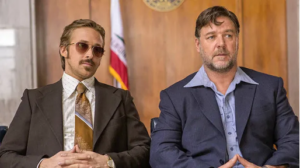
Ryan Gosling and Russell Crowe in The Nice Guys
Directed by: Shane Black
Starring: Russell Crowe, Ryan Gosling, Angourie Rice, Margaret Qualley, and Matt Bomer
Released: May 20, 2016
I liked The Nice Guys from the beginning, but it took me a while to figure out why.
The story itself isn’t especially original. Holland March (Ryan Gosling) is a private detective working in Los Angeles in 1977. He’s a bit of a mess – an alcoholic, a mediocre father, and not nearly as competent at his job as he would like people to believe.
Jackson Healy (Russell Crowe) is something quite different. He’s a hired enforcer. People pay him to beat up people they don’t like. He’s bigger, tougher, and considerably less neurotic than March.
The two meet when Healy is hired to beat up March.
This is generally not the beginning of a friendship. But it is the beginning of a buddy movie – and once I realized that, I understood why I was enjoying it so much.
What I Liked About It
March and Healy are almost perfectly mismatched. March talks too much, drinks too much, and panics easily. Healy is quiet, a loner, and is inclined to solve problems with brute force. March is ridiculous in situations where Healy is calm. Healy is fierce in situations where March is frightened. And because their reactions are so different, the same situation can be suspenseful and funny at the same time.
That is what The Nice Guys does particularly well.
The two men are forced together when they go looking for a missing young woman named Amelia (Margaret Qualley). What begins as a relatively simple investigation leads them into the pornography business, the automobile industry, government corruption, and a growing collection of people who seem quite willing to kill them.
The plot gets complicated. I didn’t much care. The pleasure is watching Crowe and Gosling deal with it.
Gosling surprised me. I had always thought of him primarily as a dramatic actor, but he is very good at physical comedy. There are scenes in which March tries to maintain his dignity while bleeding, falling, screaming, or otherwise making a fool of himself. Gosling doesn’t play these moments as jokes. He plays March seriously, which makes them considerably funnier.
Crowe has the less showy role, but he is just as important. He gives Gosling something solid to bounce against. Healy is the straight man most of the time, although gradually we discover that he isn’t nearly as simple as he first appears.
And then there is March’s 13-year-old daughter, Holly (played by Angourie Rice). She could easily have been the annoying movie kid – the precocious child who exists mainly to say clever things adults would never say. Instead, she becomes a genuine third member of the team. She is smart without seeming like the screenwriter was showing off, and in some ways she has a stronger moral sense than either of the two men.
The supporting cast is unusually good for a movie of this kind. Margaret Qualley is convincing as Amelia, and Matt Bomer is particularly effective as John Boy, the principal killer. He has the pleasant face and manners of someone you might trust with your luggage, which makes what he does considerably more unsettling.
Those characters give the movie a little more texture than it strictly needs. Genre movies can work perfectly well with cardboard villains and disposable supporting characters. The Nice Guys doesn’t settle for that.
What I Didn’t Like So Much
I can’t think of much I disliked. I wasn’t bored. I liked the actors. I laughed a lot. The action worked. The 1970s Los Angeles setting was fun to look at without becoming a costume party. And at just under two hours, the film moved along nicely.
Still, while I was watching it, I kept thinking about other buddy movies.
That may have been the problem.
I thought about 48 Hrs., with Nick Nolte and Eddie Murphy. I thought about Lethal Weapon, with Mel Gibson and Danny Glover. And especially Midnight Run, with Robert De Niro and Charles Grodin. Those movies begin with essentially the same trick: Take two people who would probably cross the street to avoid each other, lock them together, and then throw increasingly difficult problems at them until hostility turns into dependence and, eventually, affection.
The Nice Guys does all of that. But the best buddy movies do something more. At some point, almost without noticing it, you stop enjoying the relationship simply because it is funny and begin caring about the friendship itself. De Niro and Grodin achieve that in Midnight Run. Gibson and Glover do it in Lethal Weapon. By the end, the relationship has acquired an emotional weight that wasn’t there at the beginning.
I never quite got that far with March and Healy. I liked them. I enjoyed watching them. And I would happily watch another movie with the two of them. But I didn’t feel quite as much about them as I did about those earlier pairs – which is, admittedly a high-expectation complaint.
Critical Reception
The Nice Guys received very good reviews when it came out, including a 91% critics’ score on Rotten Tomatoes. A few examples:
* Ryan Gosling has “dynamite timing and uproarious gestures” and “becomes a blast.” (TimeOut)
* Gosling and Crowe make “a surprisingly brilliant comedy duo.” (RogerEbert.com)
* “It’s all delightfully fizzy, bloody fun.” (The Globe and Mail)
* “Constantly funny, startlingly violent, and oddly heartfelt”…“a grown-up delight.” (HitFix)
My Rating
The Nice Guys gave me almost everything – so I give it 8.5 out of 10.
Worth Considering
Three Quick Bites
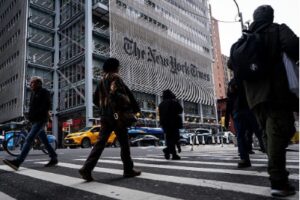
Midtown Manhattan
“The NYT Sued by Shareholders Over Biased Israel Coverage”
The New York Times has been on the wrong side of every major geopolitical crisis since WWII, and they are doing it again with their reporting on the Arab/Israeli war. In a suit filed against the paper, some of its shareholders brought plenty of evidence that it was systemically antisemitic… at least that’s how I see it. Read this (particularly the specific charges) and decide for yourself.

Shenzhen China
“The real reason Chinese AI is winning the global south”
“Chinese open-weight models – artificial intelligence systems whose underlying weights are publicly released – are having a moment. Alibaba’s Qwen, for example, boasts 151,448 derivatives on Hugging Face. These are customized adaptations, where programmers fine-tuned the Qwen architecture for their specific needs. That gives Qwen a repository footprint 4.7 times that of Meta’s Llama and almost double that of Google’s Gemma.” Read more here.

The Top 24 Gen Alpha Slang Terms of 2026
You will cherish this if, like me, you are in a meeting with Gen Alpha employees and they are using terms like “chug” and “rizz” and you don’t know what the hell they are talking about but you don’t want to ask and give away your age.
Social Issues
Readers Write re “The Most Interesting Thing About AI” in the Sept. 29 issue
From AG: “You nailed it! AI, properly used, is an incredible tool to help you consider things differently, to think better and reach better conclusions. The $100 a month I spend for my Claude subscription is arguably the best money I’ve ever spent on anything… ever. And arguing with AI is so much better than arguing with a blowhard, even a really smart one. Especially when you’re wrong, since there isn’t a crowd around to witness it.”
Worth Considering
Postscript: Bird Photographer of the Year

“Sunball Rocket” by Henley Spears, Overall Winner
Some spectacular award-winning photographs from a contest named simply The Bird Photographer of the Year. And check out the winner of the video award – Bald Eagles catching fish on the surface of raging waters.