I’m writing this from Seoul, South Korea. K and I will be here for five days before flying to Tokyo, where we’ll spend another two weeks. One of those weeks will be mostly business for me. I’m scheduled to give two general-session presentations, each about two and a half hours long, before audiences of several thousand people. Then I have three more “intimate” presentations for smaller groups of VIP attendees, plus several days of meetings with the marketing and executive staffs of my Japanese publishers.
So Seoul is the calm before the storm.
I’ve been here only once before, many years ago. And that, as they say, is another story.
My impression this time began almost immediately after landing at Incheon International Airport.
I’ve had this same reaction many times during the past 30 or 40 years, particularly when traveling in Asia: “Gosh. Everything here seems bigger and better than it is in the United States!”
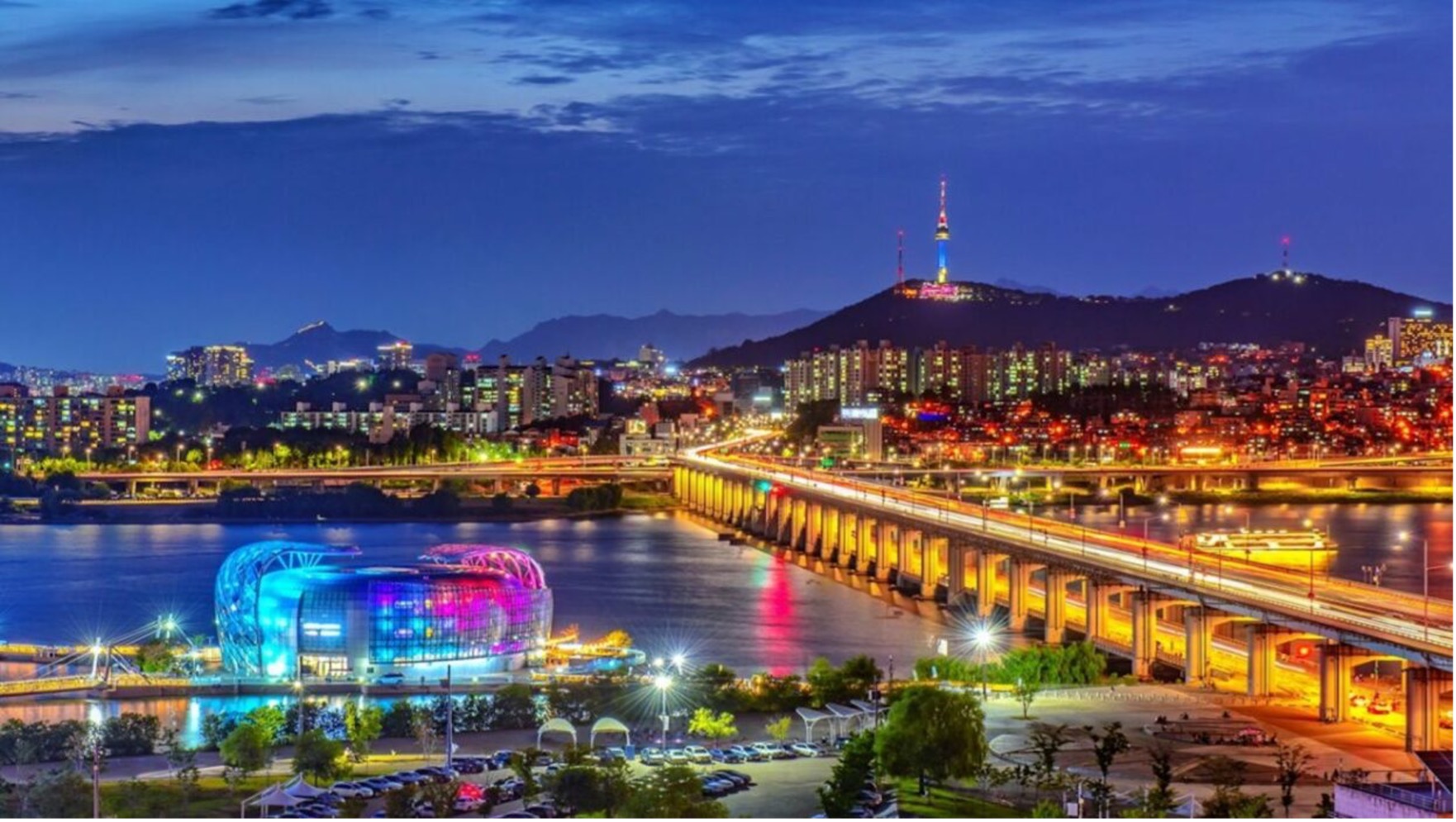
The airport was enormous. So were the highways leading into Seoul. We passed mile after mile of huge apartment developments – dozens of tall residential buildings grouped together like small cities. We crossed bridges and complicated interchanges, passed enormous commercial developments, and eventually came alongside the Han River, which runs through the middle of Seoul and in places is more than half a mile wide.
And everything looked new. Or newish. And clean. And maintained.
There were no collapsing retaining walls. No abandoned shopping centers. Very little litter blowing around. No guys living under the overpasses.
That last observation may not survive another four days of inspection, but it was my first impression.
Then we got into Seoul itself… and it was more of the same.
Seoul proper has about 9.5 million people. The larger metropolitan area has roughly 26 million – about half the population of the entire country. Yet it doesn’t feel chaotic in the way New York can feel chaotic. The traffic is heavy, but orderly. The sidewalks are crowded, but clean. The buildings are generally well maintained.
And the people behave themselves.
At least so far.
They wait for lights. They don’t seem to throw garbage on the streets. They aren’t screaming into their phones. I haven’t seen anybody punching anybody on the subway.
Not quite Japan. But considerably cleaner and more orderly than New York. And, I’m sorry to say, most of Florida.
What makes this more interesting is that much of the Seoul I’m looking at is relatively new.
The city itself is ancient. Seoul became the capital of the Joseon Dynasty in 1394. Some of the most beautiful things still standing here go back hundreds of years. But Seoul has had the misfortune of being invaded, occupied, burned, bombed, rebuilt – and occasionally invaded again.
The Japanese invaded Korea in the 1590s, during their unsuccessful attempt to conquer China. Much of Seoul was destroyed. Gyeongbokgung, the great royal palace that K tells me we will be visiting, was burned and remained largely in ruins for centuries.
Japan came back under very different circumstances in the late 19th and early 20th centuries, formally annexing Korea in 1910. Korea remained under Japanese colonial rule until Japan’s defeat in World War II in 1945.
Those 35 years left scars that have not entirely disappeared. The Japanese tried to assimilate Koreans into the Japanese empire. Korean language and culture were suppressed to varying degrees. Koreans were eventually required to adopt Japanese-style names. Hundreds of thousands were mobilized for labor and military service. The history of Korean “comfort women” remains one of the bitterest issues between the two countries.
But World War II wasn’t what physically destroyed modern Seoul. That came five years later.
North Korea invaded the South in June 1950 and captured Seoul within days. United Nations forces took it back. Chinese and North Korean forces captured it again. It changed hands four times in less than a year.
By the time the Korean War ended in 1953, much of Seoul was wrecked.
That’s one reason Seoul is so visually interesting. You have these huge expressways, glass office towers, enormous apartment complexes, and LED-covered commercial districts. Then, sitting among them, you find a 600-year-old palace or gate that looks as if somebody dropped it there from another civilization.
South Korea’s rise since the war is one of those economic stories that everyone vaguely knows about but perhaps doesn’t sufficiently appreciate. In the early 1950s, it was a poor and devastated country. Today, it is one of the world’s major industrial economies.
It gives us Samsung, Hyundai, Kia, LG, and SK. It is a world leader in semiconductors, electronics, automobiles, batteries, and shipbuilding. And as if that were not enough, this country of only about 52 million people has convinced millions of young Westerners to listen to Korean music, watch Korean television, eat Korean food, and smear Korean cosmetics on their faces.
Enough with the stuff you can find in any travel book. Let me tell you something that hit me the moment we got on the plane in Atlanta: Koreans are taller and stouter than Japanese. And, as if to accompany their physicality, they are more outspoken and, initially at least, gregarious.
Those are broad generalizations – which, of course, are the only kind worth making. (How tedious to spend one’s life always trying to say the exactly correct thing.)
That was my initial impression. And when we got off the plane and walked through the airport in Incheon, that impression was reinforced. Not only were there more bodies that seemed American-fed, but the smaller, leaner people looked distinctly smaller than the Koreans.
Anticipating the reaction I am bound to get for sharing this observation, I decided to check it with Nigel.
Me: Am I right about this, Nigel?
Nigel: “Well, not exactly, sir. But rather more exactly than I expected.”
Me: “Meaning?”
Nigel: “Koreans actually are somewhat taller and heavier than Japanese. In one direct comparison, Korean men averaged about an inch taller than Japanese men. Korean women were about an inch taller as well.”
Me: “So I’m right.”
Nigel: “I hadn’t finished, sir.”
Me: “You never have.”
Nigel: “The weight difference was more noticeable. In that study, Korean men averaged about 17 pounds heavier and Korean women about eight pounds heavier.”
Me: “That big a difference? I’m surprised. But here’s what I think my eye was picking up. Averages don’t necessarily tell you how a population looks. If the Korean distribution is wider – if there are more very tall and very heavy Koreans – that could make the visual difference seem much greater than the difference in the averages.”
There was a short silence.
I have learned that Nigel’s silences are more dangerous than his corrections.
Nigel: “An ingenious theory, sir. Unfortunately, the numbers refuse to cooperate.”
Me: “How so?”
Nigel: “The variation in height is almost identical. In fact, the standard deviation is slightly smaller among the Koreans in this particular study. There is more variation in weight, especially among Korean men, so you may claim a modest victory there.”
Me: “I’ll take it.”
Nigel: “I thought you might. But there is a simpler explanation. Your eyes weren’t measuring height. They were looking at people. Add an inch of height to 8 or 10 – or in some groups considerably more – pounds of body weight, and the visual impression can be larger than either number sounds by itself.”
Which is probably right.
The interesting thing, at least to me, was that I noticed the difference before I knew there was one. My explanation for why I noticed it was mostly wrong.
Nigel lives for moments like these.
There are other differences I think I’m noticing.
Koreans seem somewhat less formal than the Japanese. A little louder. A little more physically expressive. Perhaps a little more rambunctious.
Japan can sometimes feel as though the entire population has agreed to a national code of conduct and everybody has memorized all 740 pages. Korea feels as though they read the book but reserve the right to argue about it.
But beneath those differences, there seems to be much that is familiar from my travels in Japan and elsewhere in Asia: respect for family and elders, consciousness of hierarchy, reverence for education, a powerful work ethic, and a greater willingness than we now have in America to subordinate individual convenience to social order.
These are generalizations, of course. Perhaps prejudices.
I’m okay with that. Generalizations are often where thinking begins. The mistake is believing they are where thinking should end.
Given Korea’s history, I also assumed Koreans would have warm feelings toward China and considerably cooler feelings toward Japan.
Nigel spoiled that one, too.
Recent Korean polling shows something close to the opposite. Japan is now viewed considerably more favorably than China. That doesn’t mean the old grievances against Japan have disappeared. Far from it. But it does suggest that nations, like people, don’t always carry their old friendships and resentments in the direction outsiders expect.
I’ll be watching for more of that during the next few days.
K has already planned most of them.
We’ll see Gyeongbokgung, the great royal palace first built in the 14th century, burned during the Japanese invasions, rebuilt centuries later, altered again during the colonial period, and now painstakingly restored. We’ll visit Bukchon, with its traditional hanok houses. We’ll see some of the old markets, temples, gardens, and neighborhoods. And we’ll spend some time along the Han River.
I’m particularly interested now in looking for the seams – the places where the old Korea and the new Korea have been stitched together.
Because that, I think, is what impressed me most during that first ride in from Incheon.
Here is a country that was colonized for 35 years, divided after World War II, invaded in 1950, and devastated by three years of war. Yet within a single lifetime it went from poverty and destruction to producing some of the most sophisticated ships, automobiles, electronics, and computer chips in the world.
And it apparently did something else that interests me even more. It modernized without deciding that becoming modern required being ashamed of what came before.
The old palaces are being restored. The old walls are being rebuilt. Traditional neighborhoods are preserved. You can stand in front of a Joseon palace and look beyond its tiled roofs at a forest of skyscrapers.
Perhaps after four more days here I’ll discover that much of what I’ve just written is nonsense.
Nigel can only hope.
But for the moment, Seoul has given me a feeling I’ve increasingly had while traveling in Asia over the past few decades.
We Americans still think of ourselves as inhabitants of the world’s most advanced country. We expect other countries to visit us and marvel at what we have built.
I’m beginning to wonder if we’ve been so busy telling ourselves that story that we haven’t noticed how much building has been going on elsewhere.
Worth Considering
A Surprising Letter from Ernest Hemingway
A book club brother/ professional musician/ brilliant conversationalist sent this to me recently…

I had read it once many years ago and liked it then, but now I like it even more. Not only is the advice so good, I love how Hemingway expressed affection.
Worth Considering
Postscript: On My To-Watch List
Wilder, a PBS documentary celebrating the talent of Gene Wilder. The trailer sold me. You can watch it here.