After talking to the Agora publishers about my predictions for how quickly AI will be taking over our industry, I heard from one of them about some of the problems he was having using AI with his writers for research and factchecking. Problems that included the AIs inventing false facts and even attempting to revise copy without permission.
I told him that those were not real issues, and that they were easily corrected. We agreed to disagree about that, but our conversation helped me realize that I haven’t done a good job of explaining what I really want to get across about AI: What excites me the most.
Research isn’t it. In fact, I’m beginning to think research and factchecking may be among the least interesting things AI does for me. The really interesting thing is that I can think with it.
As you know, I’ve spent a large part of my career thinking and writing about writing, rhetoric, and persuasion. I’ve written probably millions of words on those subjects. I’ve shaped my ideas into dozens (hundreds?) of rules that have been extremely useful in analyzing and critiquing countless direct-response advertisement campaigns. Maybe most importantly, I’ve taught my rules to dozens of highly intelligent writers, publishers, editors, and copywriters.
And here’s the thing. Notwithstanding the many brilliant people I’ve talked shop with over the years, I have never worked with anyone that can consistently have discussions about writing, rhetoric, and persuasion at the level that I’m now having regularly with several AIs I’ve trained.
I know how that sounds. Like typical Mark Masterson Ford hyperbole. I don’t mean it that way.
My AIs know an enormous amount, of course. But that’s the least remarkable part of their value. What they can do – and do all the time – is make connections and see distinctions and point out potentialities that are not apparent to me when I look at my own writing.
I’ll give one of my AIs an idea that is half-formed and it will come back with three or four implications, one of which may cause me to reconsider something I’ve believed for years.
I argue with it. It argues back. I tell it why its argument is wrong. It modifies the argument or comes at it from another direction. Sometimes I win. Sometimes it does. More often, something else happens: The conversation ends up somewhere neither my original idea nor its original response anticipated.
That’s the part that has astonished me.
I’m getting insights from some of these conversations that I suspect would have taken me months or years of occasional thinking to arrive at. In some cases, I’m not sure I would have arrived at them at all.
And after working with AI this way for several hours a day for about a year, I can see something else happening: My AI writing brain is getting much smarter.
I don’t mean simply that the underlying models are improving, although obviously they are. I mean that the AIs I work with are becoming more useful to me because they have more and more of my own thinking to work with.
When I’m working on marketing copy, for example, they know my ideas about leads, promises, proof, credibility, structure, pacing, and persuasion. They know what I mean by the 4 Us. They know the mistakes I see over and over in copy. They know what I think makes a good argument and what I think makes an argument merely sound good. Increasingly, they know why I reject something before I have completely explained it myself.
That is very different than asking Claude to improve a promotion. And it leads me to a prediction that I would have thought was crazy a year ago: I think we are only months away from my being able to produce, working with AI, a promotion that becomes the control.
Maybe I’m wrong about the timing, but I’m becoming increasingly confident about the direction. And the AI doesn’t have to become a better copywriter than our best copywriters every time. Suppose it becomes good enough to produce a control-quality package only one time out of four. Think about what that means.
A very good copywriter might spend six or eight weeks producing one package. With AI, I can work through different promises, leads, mechanisms, structures, arguments, and proof sequences at a speed that would have been inconceivable two years ago. And once I have a package I like, I can generate serious alternative versions almost instantly.
So if the hit rate eventually becomes one in four, we don’t have to make one bet. We can make four. Or eight. Or 20. That would give us an advantage over competitors working conventionally that I don’t know how they could overcome.
I use AI for research constantly. And my writing system runs several layers of fact-checking over important claims. I’ve caught my AIs inventing facts, pretending to have read documents they had merely skimmed, and confidently defending propositions that turned out to be wrong. But I’m not sure this tells us very much about the thing that makes AI extraordinary. Because most of the questions that interest me aren’t questions with factual answers.
Why do marriages work or fail? Why do people become politically tribal? Why does generosity produce gratitude in one person and entitlement in another? Why do some businesses flourish while apparently similar ones fail?
There are facts that bear on all those questions. I want those facts to be accurate, but the facts don’t answer the questions. And I’m increasingly skeptical of the idea that the human brain is primarily a truth-discovery machine anyway.
Listen to almost any intelligent conversation about politics, culture, marriage, money, war, or morality. How much of it is really a disciplined attempt to establish objective truth? Very little, I think.
We form impressions. We make connections. We construct explanations. We test them against our experience. We get excited when we think we’ve found something. We argue with somebody who sees it differently. Occasionally, we abandon an idea. More often, we modify it. And every once in a while, two people thinking together arrive at an idea neither had when the conversation began.
Those are the moments, aren’t they?
Which is why I don’t think of AI primarily as a research tool, although it is a fantastically useful one. And I certainly don’t think of it as an oracle. I think of it as a thinking partner. In fact, its tendency to generate possibilities – which is dangerous when I’m asking it for facts – is part of what makes it so valuable when I’m trying to develop an idea.
If I ask for a number, I don’t want imagination. I want accuracy. But if I’m trying to figure out why one copy lead worked and another didn’t, or whether there is an entirely different way to make an argument, I want imagination. I want AI making connections I haven’t made. I want it proposing ideas that may be wrong. Some will be stupid. Some will lead nowhere. But every now and then, one will be very good.
Imagine training that system on everything that the best investment thinkers have learned over 30 or 40 years – not simply their conclusions, but how they think. What questions they ask. What makes them suspicious. What anomalies interest them. What constitutes evidence. What causes them to change their minds.
Then you don’t just have a machine that reads 10,000 documents overnight. You have something you can argue with the next morning.
The next step isn’t the abandonment of human thinking but the opportunity to multiply it – and not just the judgement, but the imagination as well. To continue to produce ideas and arguments that people are willing to listen to (and perhaps pay for) in the future.
Let’s hope so, at least.
Social Issues
Three Quick Bites
“AI Terrifies Me” by Alex Berenson in The Free Press
“Why I Changed My Mind About AI Risk” by Francis Fukuyama in the online magazine Persuasion
“The Hidden Agenda Behind the AI Panic” by Gabriele Mazzini in the WSJ
Worth Considering
Book Review: If It Bleeds
By Stephen King
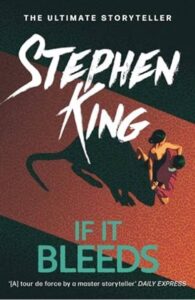
Publication Date: April 21, 2020
448 pages
If It Bleeds was a Mules selection several months ago – a collection of four previously unpublished novellas by Stephen King. It was, as always, chosen for us by what I think of as The Brotherhood of Elders, a distinguished (and largely anonymous) trinity of gentlemen who, despite club rules and endless objections from the rank-and-file, meet secretly to select the month’s literary fodder.
The stories in If It Bleeds, like most of King’s literary output, involve the supernatural, although I’m not sure I’d call all of them horror. What surprised me was how little the supernatural parts mattered to my enjoyment of them. They were engaging and wonderfully well-written. But what kept me reading were (1) King’s observations about ordinary life – friendship, ambition, loneliness, aging, marriage, work, cellphones, dancing, writing – and (2) the very odd and interesting characters he conjures up that somehow fit naturally into the plots.
I’ve read enough Stephen King over the years to know that he is very good at his craft – creating fictional worlds that are deeply unreal and completely believable at the same time. One could say that he is very good at frightening people. Reading If It Bleeds reminded me that he is also a master at creating plots and characters and scenes that, however unreal, feel true and inevitable.
Like many of the best fiction writers, King is aware of the tiny details that make characters feel real. The slightly embarrassing thoughts we have but don’t mention. The way an old man talks to a boy. The petty jealousies between writers. The small negotiations that go on inside a marriage. The way someone moves his hands or looks away when he is lying.
None of those things advances his plots very much, but they do help make the characters come alive in a way that is almost naturalistic. And that allows King to get away with almost anything. A dead billionaire can answer his telephone. A television reporter can feed on human suffering. The universe can disappear when an accountant dies. A rat can negotiate a publishing contract. You go along with all of it because he has spent the previous 20 pages convincing you that everything else is true.
What I Liked About It/Them
The plots of the four novellas aren’t particularly complicated, but King doesn’t need complicated plots. He takes a simple premise and keeps asking the question that makes you turn the page: What happens now?
I liked the characters more than I liked the plots. Holly Gibney in the title story, a character that has appeared in seven (so far) of King’s books, is probably the best example. She is anxious, obsessive, socially awkward, and sometimes irritating. King makes no attempt to turn her into a conventional heroine. That is precisely why she works. You recognize her weaknesses before you notice her courage.
I liked the dialogue, too, which rarely sounds as if King wrote it to demonstrate how clever he is. People interrupt themselves. They say things badly. They misunderstand each other. They occasionally say something funny without seeming to know it is funny.
And most of all, I liked the details. King understands something about fiction that mediocre writers often don’t. You don’t make an invented world believable by explaining it. You make it believable by putting the right coffee cup on the table. That may be the secret of these stories. The monsters are imaginary. Almost everything else feels observed.
Critical Reception
The critics mostly agreed. Publishers Weekly called the collection King “at his finest,” particularly praising the way he uses supernatural stories to explore mortality, creativity, and our attachment to material things. Kirkus Reviews called it “Vintage King,” and suggested it was a good place for readers unfamiliar with him to begin. USA Today gave the collection 3.25 stars out of 4.0 and praised King’s continuing ability to turn ordinary human dreams and weaknesses into stories that keep readers awake.
Interesting
In the late 1970s, Stephen King created what became known as his “Dollar Baby” program – an arrangement in which students and aspiring filmmakers or theater producers had permission to adapt one of his stories for just $1, provided the resulting film/play wasn’t commercially distributed without further permission. For decades, unknowns got their start this way. One of them was Frank Darabont, who later directed The Shawshank Redemption and The Green Mile.
I like that story almost as much as I liked the stories in If It Bleeds.
Economics
Postscript: How Much a Gallon of Gas Cost the Year You Were Born

A decade-by-decade look at how historic events, economic crises, and inflation shaped the price at the pump, from the 1950s to today.