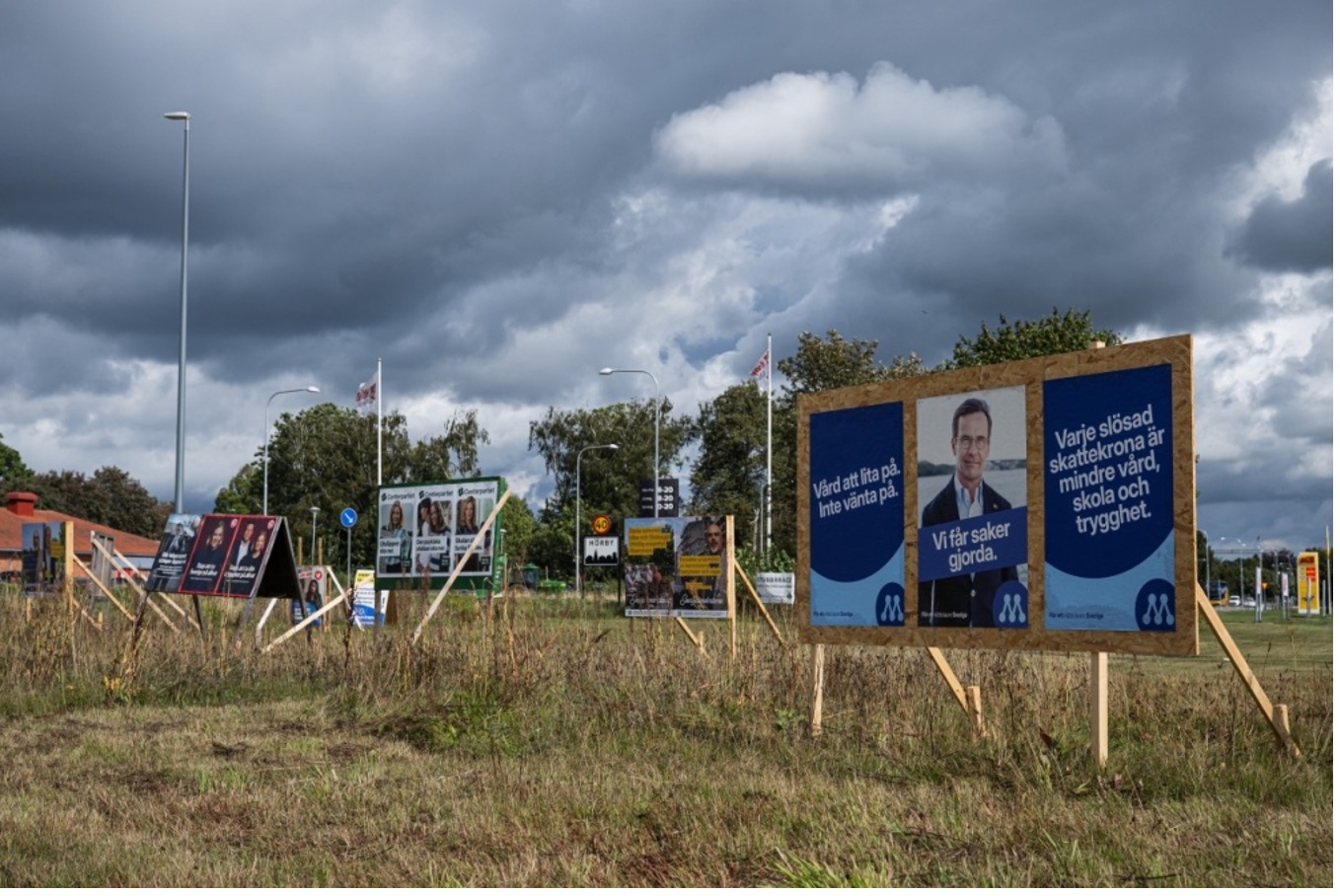
Election campaign posters for Sweden’s political parties displayed ahead of the country’s general election on Sept. 13.
I talked about Sweden, Denmark, and Finland in Monday’s issue. About the fact that they were among the world’s most generous countries toward refugees and immigrants for decades – and then, gradually at first and much more quickly after 2015, began changing their minds.
The question is why?
The obvious answer is that they simply became less tolerant. That is certainly how some critics explain it. But I think there is a more interesting explanation. And I suspect it has as much to do with culture as economics.
The economic problem came first.
The Scandinavian welfare states are enormously generous. But they can afford to be generous because so many adults work and pay relatively high taxes. The system depends on that. It also depends, I think, on an unwritten agreement that people who are able to contribute are expected to contribute.
Many of the refugees who arrived were poorly equipped to enter those labor markets. Some had little formal education. Many couldn’t speak the language. And countries like Sweden have relatively few jobs for people with few skills.
The result was predictable. Immigrants, particularly those with less education, had considerably lower employment rates than native-born Swedes. Many remained dependent on government support for years. That was already causing political friction when, in 2015, the numbers suddenly exploded.
Sweden received about 163,000 asylum seekers that year. That was roughly 1.6% of its entire population arriving in a single year and, at the time, the highest per-capita influx ever recorded in an OECD country. Finland received more than 32,000 asylum seekers, nearly 10 times the number it had received the year before.
Problems that had been developing slowly became much harder to ignore. Housing was scarce. Schools and local governments struggled to absorb the newcomers. Immigrant neighborhoods became increasingly segregated. And getting large numbers of poorly educated refugees into jobs proved much harder than politicians had hoped.
Then there was crime. Some immigrant groups, particularly young men from non-Western countries, are overrepresented in Scandinavian crime statistics. But the raw numbers need qualification. Immigrant populations tend to be younger, poorer, less educated, and more concentrated in high-crime neighborhoods. Adjust for those factors and some of the difference disappears.
Still, I don’t think economics or crime by themselves explain what happened. There was something else going on that is harder to measure.
These are relatively small countries with strong and, until recently, fairly homogeneous cultures. They have deeply rooted expectations about working, learning the language, educating your children, treating women equally, accepting secular government, obeying the law, and behaving properly in public.
Much of the new immigration came from the Middle East, Africa, and other places with very different histories and cultural traditions. That doesn’t make those cultures inferior. But it does make them different in ways that can matter when large numbers of people from one culture move rapidly into another.
Multiculturalism assumed those differences could coexist without much friction. Perhaps that assumption was too optimistic.
The Scandinavian governments provided newcomers with housing, health care, education, language training, and financial support. The theory was humane and reasonable: Give people the help they need to establish themselves and, over time, they will become integrated into their new country.
For many immigrants, that’s exactly what happened. They learned the language, got jobs, raised families, and became productive citizens. Any fair account of Scandinavian immigration has to acknowledge that.
But it didn’t happen with everyone. And when integration failed, behavior that may have had complicated causes began to look very different to the people paying for the system.
What an immigrant regarded as an entitlement, a Swede might have regarded as dependency. Behavior considered normal in one culture could look like bad manners in another. Different attitudes toward women, religion, authority, and the police could produce more serious conflicts. And when crime was added to the mix, the argument stopped being merely about generosity.
That, at least, is how I see it.
The problem wasn’t simply that Scandinavia had admitted too many immigrants. It had admitted large numbers of people from cultures very different from its own while assuming that generous social programs would eventually close the cultural distance.
They didn’t always do that. And gradually the political question changed. Instead of asking, “What should we do for the people coming here?” voters began asking, “What should we expect from them?”
Denmark got there first. Beginning in 2001 and 2002, it tightened asylum, family reunification, permanent residency, and welfare rules. Sweden held out much longer. But after the 2015 refugee crisis, even Sweden imposed border controls, restricted family reunification, and began replacing permanent residence permits with temporary ones for many asylum seekers.
The politics changed with it. The Sweden Democrats, once considered a fringe party largely because of their opposition to immigration, became one of the country’s largest political parties. Finland’s Finns Party followed a similar path. Perhaps more telling, mainstream parties began adopting immigration policies they would have rejected 20 years earlier.
I used to think the Scandinavian countries were able to maintain unusually generous welfare systems because they were rich. I now think that was only part of it. Their welfare states were also built on something money can’t buy very easily: a high degree of social trust and a broadly shared understanding of how citizens should behave toward one another.
That may be the real lesson of the Scandinavian immigration experiment.
A generous welfare state can redistribute money. It can provide housing, education, medical care, and food. It can even teach a new language.
What it cannot easily do is manufacture a common culture.
Worth Considering
Three Quick Bites

“DOGE Works. Let’s Keep It Going,” by Tyler Hassen in the WSJ
“When I graduated from college in 2005, the national debt was about $8 trillion. It recently passed $40 trillion and is on pace to surpass $100 trillion by the time my 5-year-old daughter is in her mid-20s. Yet what are we doing about it as a country?
“Not all lawmakers seem serious about solving this crisis. But I saw what can happen when talented people leave their private-sector lives for a mission to eliminate the deficit. Did we achieve it? Of course not. DOGE’s inability to dent the debt materially has been written about. Striving for a balanced budget became a partisan phenomenon. Critics questioned whether every dollar of the $215 billion on our public savings tracker was real. But by quibbling over line-item labels and the definition of ‘savings’ while the debt compounded, they missed the point.
“To address the debt, we need to …”
Read Hassen’s entire article here.

A CEO That Can’t Get Enough of Customer’s Complaining
This story is important. It’s about a general truth about marketing that even some of the best marketers forget. It’s another level of Pareto’s Law. If 20% of your customers produce 80% of the revenue, then 20% of that 20% (or 4%) will produce 80% of the 80%, which is 64% of your revenues.

Why Good Times Create Weak People:
Aristotle and Nietzsche on Socialism
When I first saw this guy (“Liam-Out-Loud”), I found his way of speaking distracting. But his scripts were good, and so I became a student of his. Now I find his odd expressiveness almost enchanting. Here, he explains Nietzsche’s critique of Socialism in terms of ethics, and he does a good job of it.
Worth Considering
Postscript: An Origami Masterpiece

A meticulously crafted manual typewriter made from a single uncut sheet of paper measuring 124 cm (1.36 yards) across. This video follows the 24-hour creation process from the initial design through the complex folds that form the keyboard and other intricate structural details.