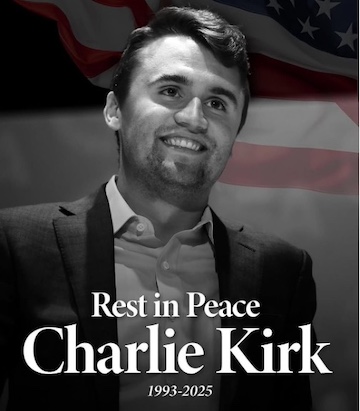
Charlie Kirk was assassinated a year ago, on September 10, 2025.
I was an early fan of his work – when he was engaging with college students throughout the United States by sitting at a folding table and, as they passed by, asking them to stop and talk about political and social issues in the news at the time.
He had an earnestness about him that stayed with him even when he was speaking to thousands of people in sold-out auditoriums. Because he was a conservative and a Christian, the mainstream media treated him like he was a danger to society. Many of my leftist friends and colleagues have that impression of him even today.
Click here to watch several videos of him doing what he was repeatedly warned could end his life: having open discussions and debates with liberal and leftist students on college campuses.
Worth Considering
Book Review: The Paris Wife
By Paula McLain
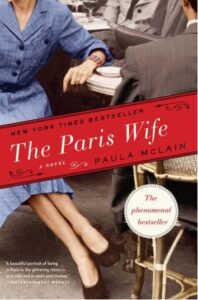
320 pages
Published 2011
Why I Chose This Book
I found it in a little bookstore while on a family trip to Georgia a few months ago. It was sitting in a small section of books by and about Ernest Hemingway.
I’ve been a Hemingway fan since I was a teenager, and I have an avid interest in his life. I’ve never read the big Carlos Baker biography, the 700-page one that everyone cites. (I keep meaning to. I’ve been meaning to for about 40 years.) But I’ve read more than a dozen smaller books about him, and I thought I knew them all. I’d never heard of The Paris Wife.
I figured from the title that it had to be about Hadley Richardson, his first wife. That was enough to get me to buy it. I’ve always felt sorry for Hadley. He wooed her, married her, took her across the ocean, made her part of the most famous literary scene of the century, and then dumped her for Pauline Pfeiffer, a rich girl with better clothes.
The premise had all the earmarks of the kind of books I don’t read: romance novels. And yet, when it comes to Hemingway and his women, I can’t get enough. I’ve never quite understood why, but I think I understand it a little better now. I’ll get to that.
What It’s About
The Paris Wife is biographical fiction – the story of the marriage of Ernest Hemingway and Hadley Richardson (1920 to 1927) told in Hadley’s voice. Almost everything in the book happened. What McLain adds is what Hadley thought and felt. What it was like to be the wife.
I found it to be engaging from beginning to end. What held me strongest were the scenes that let me “see” so many of the stories I’d heard about Hemingway’s torrid love life, and understand why, at the end of his life, he wrote that he wished he’d never loved another woman after Hadley.
For example:
* The party in Chicago, October 1920. Hadley is 28, a quiet, sheltered woman from St. Louis. Ernest is 21, a war hero with big plans to be a great writer one day. They dance. He talks. She’s a goner. Her friend Kate takes her aside and warns her that he’s a womanizer. You can see the whole marriage in that one evening.
* The valise. This story physically hurts me every time I read or hear about it. Hemingway has an opportunity to be considered for a writing job. Hadley packs his bags before he goes, including a valise with his original copies of everything he had written up to that point. A valise that get stolen from her at the Gare de Lyon.
* The skiing trip in Switzerland, when Hadley tells Hemingway that she’s pregnant and he is furious. A baby, he believes, will end his career before it starts.
* The winter in Austria, when Pauline comes to stay. She’s rich, chic, and smart. She admires Ernest’s work. She has become Hadley’s closest friend. The three of them ski and drink and play cards. You watch the inevitable happen through Hadley’s eyes. A heartbreaker.
* The summer in the South of France, when Hemingway suggests that the three of them try to make it work. Hadley has to put up with Pauline in the house and, finally, in the bed while she pretends to sleep. The most painful scene in the book.
* The phone call in 1961, when Hemingway, weeks from his death, calls Hadley to tell her he’s writing about their Paris years.
What I Liked About It
I went into the book with modest expectations, and it beat those expectations on two counts. The biographical material, a good deal of which was new to me, was one. The bigger surprise was the writing.
McLain writes clean, strong prose. She has obviously read Hemingway, and she has resisted the urge to imitate him – an urge that has sunk many better-known and would-be writers. (I’ve tried it myself. Don’t.) Hadley’s voice is plain and direct and a little formal, the way a well-raised Midwestern woman in 1921 would have sounded – and about a third of the way in, I realized that it was doing a lot of work. It let me see Ernest the way she saw him, before I could bring in what I knew.
And that’s another thing that’s impressive about the book. The reader begins it knowing how it ends. So the suspense comes from living the story through Hadley.
She sees the signs. Kate’s warning at the party. The way Hemingway talks about his mother. The way he goes cold after they make love. The rage when she tells him she’s pregnant. She sees all of it, and she stays. And McLain makes you understand why she stays.
The Paris Wife is strong in the two dimensions I use to judge a novel: its verticality (how deeply it goes into what a human is) and its horizontality (how well it builds a world – a time, a place, a culture). Paris in the 20s is done in the kind of detail that makes you want to reread A Moveable Feast, which I did. The cafés, the cold apartments, the bullfights, the money worries of people who are about to be famous. All of it feels right.
There’s one more thing I liked, and I didn’t see it coming. Somewhere in the second half, I stopped feeling sorry for Hadley and started feeling sorry for Ernest. This is a book told entirely by the woman he wronged, and by the end of it, she has won and he has lost. She got the rest of her life. He got Pauline, and then Martha, and then Mary, and then the shotgun.
Which brings me back to my aversion to romance novels (though I’m fairly sure this isn’t one). What pulls me to the story of Hemingway and his wives, I think, is the same thing that pulls me to the story of any man who made something great. I want to know what it cost, and who paid. In Hemingway’s case, a great deal of the cost was paid by other people, with the first and biggest installment paid by Hadley. That’s a story about ambition. And anyone who has built anything will recognize it (I did), whether he wants to or not.
What I Didn’t Like So Much
Just a few things.
* The interludes. Every so often, McLain steps out of Hadley’s head and gives us a few pages from Ernest’s or Pauline’s point of view about their affair. I understand why she did it. But every time it happened, it broke the spell. The book’s power comes from the limits of what Hadley can see. Widening the lens weakens it.
* Some of the dialogue. McLain’s Ernest sometimes talks like the Hemingway of the parodies, all short flat sentences and “it was good.” The real man, by every account, was a wonderful and funny conversationalist, and the flat patches don’t do him justice. This is a minor gripe. Most of the time, McLain gets him.
* The pace of the last 100 pages. Once Pauline shows up, the story is a slow-motion car wreck. I found myself wanting it to hurry up and end, which is just what Hadley must have felt. Maybe that was McLain’s point – but it was the only stretch where I put the book down for a day.
Critical Reception
The Paris Wife was a big commercial success. It went to the top of the New York Times bestseller list soon after it came out in 2011 and became an international blockbuster. The novelist Helen Simonson praised it for “its depiction of two passionate, yet humanly-flawed people struggling against impossible odds – poverty, artistic fervor, destructive friendships – to cling on to each other.”
Several critics were less impressed. Janet Maslin, for example, reviewing the book for the NYT, found McLain’s Hadley to be “a stodgy bore.” I understand the complaint. Hadley isn’t witty. She isn’t glamorous. She spends a lot of the book waiting for a man to come home. If you want your heroine to sparkle, she won’t. But I think Maslin missed what McLain was up to. Hadley is the still point in a book full of brilliant, restless, self-destroying people. She’s the one who doesn’t need to be the most interesting one in the room. By the end, that turns out to be a kind of strength none of the others have. Stodgy is one word for it. I’d pick another.
Interesting
* Hadley was eight years older than Ernest. She was 29 when they married; he was 22. By the standards of 1921, that was a bigger gap than it sounds now.
* The stolen valise included drafts of a war novel that Hemingway never tried to rewrite. Scholars still argue about whether the theft of the valse was a disaster or a gift. Hemingway himself said that it forced him to start over with the spare style that made him famous.
* Hemingway’s royalties from The Sun Also Rises supported Hadley and their son Jack (a.k.a. Bumby) for years. Jack grew up to be a conservationist, an avid fly fisherman, a writer, and the father of the actresses Margaux and Mariel Hemingway.
About the Author

Paula McLain earned an MFA in poetry from the University of Michigan – and her own story is worth knowing. She and her two sisters were abandoned by their parents and grew up in a string of foster homes. So it’s not hard to see why she’s drawn to women who got written out of the story.
McLain published two books of poetry and a memoir before turning to biographical fiction with The Paris Wife. She has said she got the idea for it after reading A Moveable Feast, Hemingway’s memoir of the Paris years, in which he writes about Hadley with a tenderness he never showed any of his other wives. And she has stuck with the formula. Love and Ruin (2018) is about Martha Gellhorn, Hemingway’s third wife.
My Rating
* Verticality: 3.9 out of 5 – Goes deep on one character, and that turns out to be enough.
* Horizontality: 4.5 – Paris in the 20s, done by someone who did the research.
* Literary Richness: 4.2 – Clean, disciplined prose that never tries to out-Hemingway Hemingway.
* Bonus Points: 0.2 – For giving Hadley a self, 70 years after everyone else stopped bothering.
Overall Score: 4.4 out of 5.0 – Recommended, and not just for Hemingway nuts like me.
Worth Considering
Three Quick Bites

Another world championship for Renato!
Renato Tavares, my longtime friend and BJJ coach, did it again! (By the way, he has at least six stripes on his belt. It’s just like him to wear a belt with none.)
When Jews Were Funny
A 90-minute documentary about the history of “Jewish” humor in America. The title is a bit confusing because Jewish comedians and comic writers are still at the top of the ladder today. What I liked about it, however, is the attempt to figure out if there was and still is a particularly Jewish sense of humor.
“On starting over, how to train and how to compete, and the magic of consistency”
James Clear is good at coming up with pithy truths. One example: “Obstacles shrink or expand in proportion to your enthusiasm.” Read more here.
Worth Considering
Postscript: The Youngest Person in History…

You can’t doubt the skill, but do you believe the story?