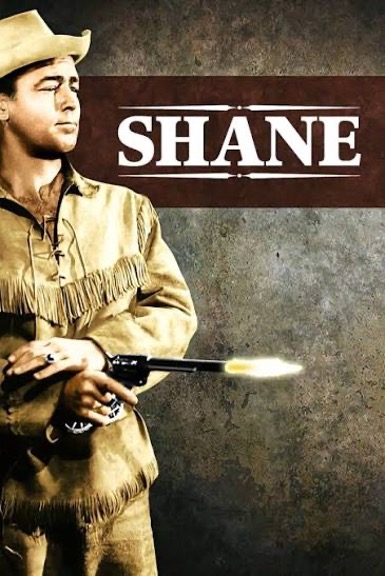
Directed by George Stevens
Starring Alan Ladd, Van Heflin, Jean Arthur, Brandon deWilde, Jack Palance
Adapted from the 1949 novel by Jack Schaefer
What It’s About
A handsome young stranger drifts into a valley oppressed by thugs; reluctantly agrees to help; is unbeatable with his fists, unmatched with his pistol; calm, courteous, gentle with children, quietly irresistible to a good woman. He kills the bad men and rides off, leaving a wife and boy to mourn the leaving.
What I Liked About It
The visuals are amazing. Nearly every outdoor frame sits in the Wyoming valley with the Grand Tetons standing behind. There is also the very dramatic way the inside scenes were photographed, lit up and shadowed very deliberately according to the plot line.
And then there is the imagery of the weather, a prominent feature of the film. It reminded me very much of Kurosawa – specifically Throne of Blood (his Macbeth), where the natural world does the work of showing you what’s happening inside the characters.
The dramatic tension is depicted, stirringly, in the reactions to the weather from the cattle, the horses, the dogs. (There’s a dog that gets up and leaves the saloon when Jack Palance’s character walks in. A dog that paws at a casket as it’s lowered into the grave. Horses rearing and cattle breaking a corral in a panic during the big fistfight.)
Another thing I liked about the film was the one place it declined to paint in black & white. The fight is between a cattleman who ran his herds on open range and the farmers – squatters, really – who came in afterward, put up fences, and cut his stock off from water.
Stop and think about that from his side for a second. His way of life wasn’t obviously the evil one. It was, if anything, closer to how the Indians had treated that land for a thousand years: as God’s ground, held by no one, shared by all. You can’t share a great open range once the fences go up and the water’s parceled out.
The movie doesn’t lean hard into this. It stays a western, and the ranchers stay the heavies – but it gestures at a real moral tangle, and I give it credit for the gesture.
What I Didn’t Like So Much
I wouldn’t call the plot a cliché. I would call it an archetype of the cowboy western that seemed to hit too often too squarely on the nose. I kept hoping for some change in the action or, better yet, a change in the protagonists’ behavior that would make the film feel more real to me.
That never came. But the Kurosawa stuff that I kept noticing held my interest throughout and even my admiration at times.
I wondered whether the Kurosawa connection was deliberate, because it seemed to be. So I consulted with Nigel, who let me know that I had the lineage backwards – which, you may agree, is even better. It turns out that Kurosawa took his cues from American westerns, and his own Yojimbo was partly inspired by Shane itself.
It also happens that the director of Shane was none other than George Stevens, who served his time during WWII filming combat and the camps, and said later that the experience inspired him to make a western where “a gunshot was a horror and not a prop.”
That is exactly what I was feeling as I watched those animals responding to the sounds of violence. Ironically, Stevens’ success in creating a sense of powerful emotion though the animals made it doubly disappointing that I could not extract that same dramatic feeling from the principal human actors.
It was the secondary characters who held me. Van Heflin as the homesteader is all stubborn decency, and you believe him. Jack Palance radiates menace with almost nothing to do. Elisha Cook Jr. gets goaded into a gunfight he can’t win and makes you feel the whole doomed pride of it.
So, Shane was only partly successful. Falling short in accomplishing the heightened drama and profound emotion it seemed to be going for, but outstanding in several other important cinematic elements (the lighting and staging and sound).
Because the hero is a cliché, I had to keep reminding myself that the film was made in the early 1950s to grant it the benefit of the doubt. Which is exactly why I’m eager to read the book. The reviews I’ve seen give Schaefer high marks, and a novel has room to do what a 1953 studio western couldn’t – get inside the drifter and make him more than a posture. I’m hoping the page did what the screen didn’t. I’ve had that hope before.
Critical Reception
Shane was nominated for five Academy Awards, including Best Direction, winning for Best Cinematography/Color (Loyal Griffs). It was listed as number 45 in the 2007 edition of AFI’s “100 Years… 100 Movies” list, and number three on AFI’s Top 10 in the Western category. In 1993, the film was selected for preservation in the United States’ National Film Registry by the Library of Congress as being “culturally, historically, or aesthetically significant.” (Source: Wikipedia)
Interesting
I asked Nigel to dig up some interesting tidbits about the movie. Here’s what he had to say:
Two trifles from the production, sir, both of which reward your suspicion that the animals outperformed the leading man. To make the horses and cattle panic so convincingly in the fist-fight, the crew stationed a man in a bear suit just off-camera; the livestock were, quite literally, scared out of their wits.
And for the funeral, the dog refused to look into the grave until Stevens had the animal’s trainer lie down in the bottom of it – whereupon the creature performed its grief on cue.
As for the human star: Alan Ladd disliked firearms, and the scene of Shane teaching the boy to shoot is said to have required upward of one hundred takes.
My Ratings
Verticality (Understanding Human Nature): 3.0/10
There is no depth, subtlety, or awesomeness in Shane’s character. He’s a fiction.
Horizontality (The World It Creates): 8.0/10
Visually and in terms of plot, the movie tells an important story about the West that is seldom told.
Visual Resonance: 9.0/10
It’s hard to imagine anything that could have been done better in the early 1950s.
Acting: 7.5/10
A mixed bag and a hard call.
Directing: 7.0/10
Another mixed bag/hard call.
Editing: 9.0/10
Generally solid with extraordinary masterful “objective correlatives.”
Overall Average Score: 7.25/10
Bottom Line: Occasionally Riveting, Generally Disappointing
Nearly everything around the edges is solid to superb: the photography, the supporting cast, the flicker of moral complication in the range war. But the thing at the center – the hero the whole film is built to worship – was so worn a cliché that it kept spoiling the rest. Beautiful to look at, honorable in its ambitions, and a chore to sit through.