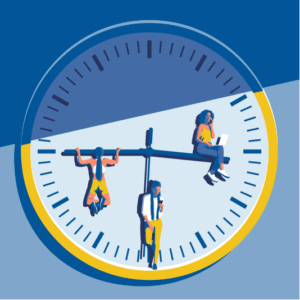
There are two kinds of power in business. Only one makes the company richer.
Tony Robbins used to tell a story about a wealthy businessman he met in the first-class cabin of an airplane.
“You’re the power guy, right?” the man asked.
Robbins said he was.
“Well, I’ve watched your infomercial for your Unleash the Power program, and I think it’s crap. The way I see it, everyone falls into one of two groups: the powerful and the powerless. Ninety-nine percent are powerless, and regardless of what you promise them, they’ll stay powerless.”
Robbins disagreed. Everyone, he said, had untapped power that could be developed and used to achieve their goals.
“Bull!” the businessman replied. “You want to see real power? Watch this!”
He picked up his drink and slowly poured it into the lap of his traveling companion, who happened to be his lawyer. The lawyer jumped up, brushed himself off, and stared at his client in horror. Then, apparently remembering who was paying his bills, he forced a smile. “That’s funny,” he said.
The businessman turned to Robbins. “That, Mr. Robbins, is power.”
When the businessman went to the bathroom, Robbins gave the lawyer one of his books and told him he didn’t have to put up with such treatment. By the time his client returned, the lawyer had decided to quit.
I don’t know if it happened exactly that way. The ending is a little too neat, the way they usually are in these stories. But I’ve always liked it because it gets at something important about power.
The businessman certainly had power over his lawyer. He could humiliate him publicly and expect him to take it with a smile. But what did he accomplish by using it? Nothing, as far as I can see. In fact, he may have damaged his own interests badly.
Suppose the lawyer had been negotiating a billion-dollar deal for him. And suppose the deal needed what the lawyer knew and who the lawyer knew. Shame him, and you lose the deal along with the man. You will have proved your power over another human being and thrown away something worth far more.
I’ve spent most of my adult life building and managing businesses. I learned early that the ability to make people do what you want is a poor measure of how well you manage them. There are better ways to use power.
Two Ways to Develop and Exercise Power in Business
I’ve come to think of power as running on two different currencies: economic and political. In business, the currency is profit. A successful business creates products and services that customers value enough to pay for and supplies them for less than customers are willing to pay.
That profit can be put back into the business to expand it, improve its products, hire more employees, raise their pay, and serve more customers. The result can be a widening circle of prosperity. Shareholders become wealthier. Employees have the chance to earn more. Suppliers and contractors benefit. Customers get better products and better service. And none of it has to come out of anyone else’s share, because a good business creates wealth that didn’t exist before.
Political power works differently. The currency of politics is power over other people, and that kind of power is relative. If I want more of it, I must take authority over people who weren’t under me before. Or cut down someone who stands between me and the people I want to control.
Political organizations can grow, of course. A leader adds managers who supervise other managers who supervise still more people. But as the hierarchy grows, the people at the bottom drift further from the people at the top. The leader knows less about their lives, has less direct experience of their problems, and may grow less sympathetic to them.
His power increases while his understanding of the people under it shrinks.
That’s a dangerous combination, and one reason I’ve always disliked office politics. The politically ambitious employee spends his time courting the executives above him, protecting his territory, building up his staff, and angling for the next promotion. He can become far more powerful without earning the business a dollar or improving the experience of a single customer. I’ve seen it happen, and I’ve seen good businesses suffer for it.
I Was Young… I Just Wanted My People to Like Me!
When I was a young manager, I had a problem I suspect many young managers have. I wanted my employees to like me. That seemed natural enough. I liked most of them, and I wanted us to enjoy working together. But I soon found that some of them saw it and were willing to use it.
They would build a friendship with me, share their problems, seek my sympathy, and then ask to be let off a rule that applied to everyone else. At first, I didn’t see it. When I finally did, I found it irritating. Sometimes I felt betrayed.
I was trying to build a successful business. I had obligations to my boss, the owners, our customers, and the other employees who depended on it. And here was someone trying to use our friendship to get me to neglect those obligations.
That taught me something that has stayed with me. A manager’s job is not to make his employees happy. His job is to create a place where they can succeed by doing good work that benefits the business and its customers.
Sometimes employees need encouragement. Sometimes they need more training or more freedom to make decisions. And sometimes they need to be told, flat out, that what they’re doing isn’t good enough. I had plenty of those talks when I was young, and I was often very direct.
Afterward, I would sometimes wonder whether I’d been too blunt. I knew the employee needed to hear what I said, and that he would be better off if he took it seriously. But I worried that the directness would breed resentment.
Could I have got the same message across with more tact? I asked myself that a lot. My answer ran something like this: Maybe someday you’ll have the skill to do that. Until then, your first obligation is to the business and its customers. You don’t get to sacrifice that because you want to be liked.
I still believe that. Several people who worked for me in those years have since become very successful and wealthy. Some have told me the demanding standards I set are part of the reason.
Would I have been a better manager if I’d been more persuasive and less blunt? Probably. But I don’t regret being tough. Not for a minute.
What I regret is that I didn’t yet have the skill to make those hard conversations easier on the people who needed to hear them.
Being tough with someone isn’t necessarily bullying him. Sometimes it’s exactly what responsible management requires.
What Being the Boss Really Means
(It’s Not Always Easy)
Over the years, I’ve come to think a manager has two basic jobs. The first is to improve the experience of the customer. That may mean better products, better service, more convenience, or lower prices. The second is to improve the profits of the business. Everything else he does should serve one or both.
Now consider the usual organizational chart. The CEO sits at the top. Below him come the executives, the department heads, the managers, the supervisors, and the staff. Authority flows downward, and at each level the person above has some power over the people below. Looked at that way, a business is a political organization.
But in a healthy business, there’s another way to read the hierarchy. Every person in it, from the CEO to the newest employee, is there to help the business satisfy its customers and earn profits. And who sits above the CEO? Two groups. The shareholders, who expect a return on their money, and the customers, who expect products and services worth paying for.
Of the two, I would put the customers slightly higher. Shareholders have the legal right to replace the CEO. But customers have the power to destroy the business simply by taking their money elsewhere.
That turns the chart upside down. The CEO looks like the most powerful person in the company. Yet he answers to people he cannot command. He can’t order a customer to buy anything. He has to earn the sale again and again, by producing results. The same holds at every level below him.
Used well, authority sets off a loop. Employees become more capable. Capable employees create more value for the customer. Customers reward that value with purchases. And the profits make it possible to create more value still. Everyone on the organizational chart has a chance to benefit.
Every Chart Was Green
There’s a wonderful example of this in the turnaround of Ford under Alan Mulally.
When Mulally became CEO in 2006, Ford was in serious trouble. The company would report a loss of about $12.7 billion that year, the worst in its history.
Mulally set up weekly meetings in which senior executives reported on their operations using color-coded charts. Green meant things were going to plan. Yellow meant trouble. Red meant serious trouble. At the first meetings, every chart was green. Think about that. The company was losing billions, yet every executive was reporting that everything was fine.
Ford had built a culture in which admitting a problem could threaten your career. Then Mark Fields, who oversaw Ford’s North, Central, and South American operations, reported serious trouble with the launch of a new vehicle. His chart was red. The room went silent. His colleagues expected the worst.
Instead, Mulally began applauding. He thanked Fields for telling the truth and asked the other executives how they could help solve the problem. At the meetings that followed, more red and yellow charts appeared. Executives began owning their problems and working together to solve them. Mulally later called that moment a turning point in Ford’s recovery.
(Look, this is a story about a well-known businessman who did what feels like the ideal way to run a business. As I’ve said 100 times, I take all such stories with a grain of salt. More often than not, they are fabrications invented by the exec’s PR people. Still, for my purposes today, let’s accept it as 100% true.)
Mulally didn’t lower his standards or suggest that poor work was acceptable. He still expected his executives to fix problems and produce results. What he changed was the price of telling the truth. Under the old system, a man protected his position by hiding trouble. Under Mulally, the way to succeed was to find trouble and help fix it.
I am happy to report that there is research that supports the idea. In a 1999 study of 51 work teams, Harvard researcher Amy Edmondson found that teams whose members felt safe speaking up learned more, and the teams that learned performed better. That doesn’t mean employees should be protected from criticism or accountability. It means a manager who makes people afraid to report problems is cutting himself off from the information he needs to run the business.
A Really Big Challenge: The Bully Who Makes You Money

Now consider a harder case. Suppose an executive runs a division that earns millions of dollars in profits. He’s intelligent, hardworking, and very good at his job. But he also enjoys intimidating employees. What should the CEO do?
Some people would say the answer is obvious: Fire him. I disagree. Getting rid of a highly productive executive can be a serious mistake. Losing him may damage the company, its customers, its shareholders, and the employees whose jobs depend on its success.
But ignoring his abusive behavior would also be a mistake. Set the moral question aside. Bullying damages morale. It discourages initiative, shuts down useful criticism, and drives talented people out the door. Gallup has found that managers account for as much as 70% of the variation in how engaged a team is. Not every unpleasant manager is unproductive. But a boss’s behavior carries far beyond the room he’s standing in.
I’ve been in this situation more than a few times, but sitting here now I can name six. (Interestingly, three were men and three were women. I would have thought most, if not all, would be men.) Each time was difficult because I didn’t want to say something that would cause one of these execs to quit. And that’s not a minute possibility. People that are able to grow profits are in a class of their own… a very small class. Nevertheless, I did have that talk. And I’m glad I did.
It meant being direct enough to make the message land, but persuasive enough not to start a fight. Sometimes that took diplomacy. Sometimes it took a quiet reminder that his position, however valuable, was still within reach of my authority. The objective never changed. Keep what he was doing well and correct what he was doing badly.
A good boss doesn’t measure himself by how much authority he uses. He measures it by the results he produces. Sometimes those results take tough criticism, direct orders, or even the threat of being fired. But whenever persuasion can do the same job, it is usually the better tool.
An intimidated employee will do exactly what he’s told, and nothing more. A persuaded employee understands the objective, believes in it, and finds ways to accomplish it that his boss never imagined. Those discoveries can be worth a great deal.
Let’s Get Back to the Man on the Plane
The wealthy businessman in Robbins’s story had enough money to make his lawyer sit through a public humiliation. But he didn’t have the judgment to see what it might cost him. He thought he was demonstrating his power. In fact, he was demonstrating his limitations in using it.
I sometimes think about how I would have ended that story if I were telling it today. It would probably end up with the lawyer quitting, getting a job with another firm with a more reasonable boss, and taking with him a $100 million contract.
And the mean boss? His business would have peaked just before it went public and then crashed because he had forced the legal team to do something untoward in putting together the prospectus.
In real life, justice doesn’t always prevail. Bernie Madoffs don’t always get caught. And plenty of very tough and borderline CEOs develop very good businesses. Still, I believe that exercising authority that way – through bullying and intimidation – is a form of power that is, at best, a second-rate solution.
Worth Considering
Three Quick Bites

Rohingya refugees watching a broadcast of the Nov. 19 International Court of Justice ruling over whether Myanmar committed genocide against their community
How the Campaign Against Israel Rewrote the Law of Genocide
There have been all sorts of Orwellian language shenanigans in the past 10 or 12 years, but none more ludicrous than the current usage of “genocide.”
“Genocide is the crime of crimes,” writes Roy K. Altman in The Free Press, “and it requires a heightened level of proof. In its Myanmar ruling, the ICJ abandoned that standard.”

“Did Xi just cuck Putin?”
“It must have sounded great in the Kremlin,” writes Seva Gunitsky in UnHerd, “three leaders of nuclear powers coming together to carve up the world. A Yalta 2.0, in which Russia finally receives its due and formalizes its sphere of influence. Putin’s foreign policy adviser, Yuri Ushakov, billed the three-way meeting with Trump and Xi as the highlight of the trip and said its significance and symbolism ‘can hardly be overestimated’. As has happened to Putin so often lately, reality turned out differently.”

Elon Musk
From the WSJ: “The Gap Between the Rich and the Very, Very Rich Is Getting Wider”
“The ultrawealthy aren’t just pulling away from average Americans. Buoyed by a stock-market boom that has added trillions of dollars to their net worth, the extremely rich are even pulling away from other rich Americans.”
Worth Considering
Book Review: On the Road
By Jack Kerouac

The original typewritten draft
Publication Date: 1957
307 pages
I’ve wanted to read On the Road for as long as I can remember. So I finally read it. And it wasn’t quite what I expected.
The book is a fictionalized account of a series of trips Kerouac made across America between 1947 and 1950. The narrator, Sal Paradise, is Kerouac. The central character, Dean Moriarty, is based on his friend Neal Cassady.
There isn’t much of a plot in the conventional sense. Sal and Dean drive, hitchhike, drink, listen to jazz, meet women, lose women, make friends, abandon friends, run out of money, find some more, and drive again.
Mostly, they are looking for something.
Kerouac described the book as the story of two Catholic friends roaming the country in search of God. That surprised me because the religious quest is seldom explicit. What Sal and Dean are consciously seeking is what they call “IT” – some moment of complete experience when life suddenly makes sense. Dean seems to believe he can get there by living harder, faster, and more intensely than everyone else. Sal isn’t so sure. But he is fascinated by the possibility.
What I Liked About It
What I liked most about On the Road was simply being there.
Kerouac lets you live inside the quotidian existence of these young men as they wander around America, discovering the Beat culture and looking for the meaning of life. He doesn’t make too much of it. That’s part of its charm.
I liked the pace, which, oddly enough for a book about people racing across the country, seemed slow and deliberate. I liked the naturalistic dialogue. And I liked the characters, particularly Dean.
Dean is selfish, irresponsible, and frequently impossible. He is also curious, energetic, funny, and astonishingly alive. Sal regards him as a kind of hero. Kerouac himself apparently saw Cassady as an archetypal American figure – both “Beat,” in the sense of being outside conventional middle-class life, and “Beatific,” reaching for something spiritual.
At times, reading On the Road reminded me of reading Hemingway, though their prose styles are obviously different. Ordinary life is allowed to be interesting. People talk. They eat. They drink. They go places. The author doesn’t keep stepping in front of the story to explain what everything means.
And almost incidentally, Kerouac gives us a marvelous portrait of America in the late 1940s: Denver and New York, San Francisco and New Orleans, highways and jazz clubs, cheap hotels and Mexican brothels, migrant workers, intellectuals, hustlers, drunks, and dreamers.
What I Didn’t Like So Much
I thought On the Road was a very good book, certainly deserving of its place in American literary history. But I didn’t think it was a great book about America in the way that, say, Lolita is.
Nabokov takes you across America, too. But he also takes you downward. Underneath the motels and highways and tourist attractions are layer after layer of psychology, language, moral ambiguity, self-deception, beauty, and horror. You can keep digging.
I didn’t initially feel that with On the Road. But the more I thought about the book after finishing it, the less certain I became.
The key is Dean.
At the beginning, Sal is in awe of him. There is something almost Gatsby-like about the relationship. Sal, like Nick Carraway, has attached himself to a man who seems to possess some quality of life that he himself lacks. There may even be a homosocial or faintly erotic element to Sal’s fascination with Dean. I didn’t read Sal as homosexual, and the novel gives us no reason to conclude that he is. But the emotional attraction between the two men sometimes seems larger than ordinary friendship.
The man Sal initially regards as almost heroic gradually becomes pathetic. Dean’s freedom begins to look like compulsion. His search for experience becomes an inability to stop. He abandons wives, children, and friends. He keeps moving because movement itself has become the point.
That made me wonder how much irony Kerouac intended.
I don’t think On the Road is satire. Kerouac’s affection for Dean seems too genuine for that. But something more interesting may be happening.
Dean thinks he is searching for God. And in a way, his method – sex, drugs, jazz, movement, rejection of bourgeois convention, the relentless search for transcendence through experience – anticipates much of the hippie culture that followed the Beats. But Dean doesn’t find God. He gets lost.
That gives the book more verticality than I first credited it with. Dean is finally a tragic figure. The qualities that make him so attractive to Sal are largely the same qualities that destroy him.
Critical Reception
The critics began arguing about On the Road almost immediately.
On Sept. 5, 1957, the day the book was published, Gilbert Millstein gave it an extraordinary review in The New York Times. He called its publication a “historic occasion” and predicted that On the Road would become for the Beat Generation what The Sun Also Rises had become for the Lost Generation. The review made the previously obscure Kerouac famous almost overnight.
Other critics weren’t so sure.
Phoebe-Lou Adams, writing in The Atlantic a month later, liked the writing but complained that the novel repeatedly seemed to promise a larger revelation that it never quite delivered. Her objection was remarkably close to mine: Dean was fascinating as an individual, she thought, but the book never quite transformed him into something universally meaningful.
Truman Capote eventually supplied the most famous put-down: It wasn’t writing, he said in effect, but typing.
History has treated Kerouac more kindly. On the Road is now firmly established as an American classic.
Interesting
You may have heard that Kerouac wrote On the Road on a giant roll of paper. That he sat down at his typewriter and produced the famous draft in three weeks.
The legend makes it sound as if the novel simply exploded out of him. It didn’t.
Kerouac had been thinking about and working toward the book for years. And after producing the scroll, he spent another six years trying to get the book published, revising it substantially along the way. The original scroll is longer than the 1957 novel, uses the real names of Kerouac and his friends, and differs in structure and tone. His editor, Malcolm Cowley, later maintained that Kerouac did considerably more revision than Kerouac’s own term for describing his technique – “spontaneous prose” – suggested.
I like that fact because it changes the way I think about the book.
My Rating
* Verticality: 4.0 out of 5.0
* Horizontality: 4.5
* Literary Richness: 4.5
* Plus bonus points for endurance
Overall Score: 4.6 out of 5.0
Worth Considering
Postscript: The Art of Hand-Pulled Intaglio Prints
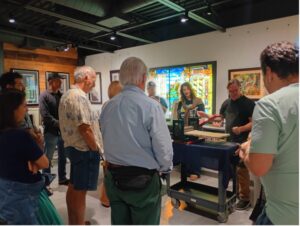
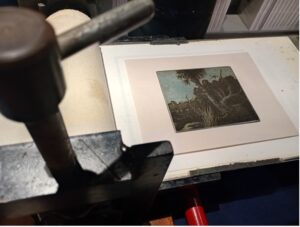
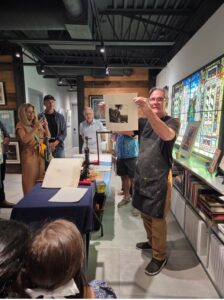
On Sunday, Nov. 15, the Museum of Central American Art (MoCAArt) in Delray Beach hosted master printmaker, artist, and educator Ron Garrett for an interactive printmaking demonstration. Visitors had the opportunity to see the process up close – from the prepared plate and application of ink to the transformation of the image into an original work of art.
Here are some photos from the event: