
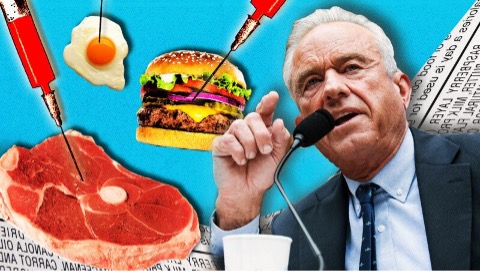
I read an article in Reason Magazine yesterday evening that started a fight between two beliefs I’ve held for most of my adult life. The fight isn’t over yet. I’m writing this partly to figure out who’s winning.
The article was about a new rule Robert F. Kennedy Jr. announced as Secretary of Health and Human Services. It has to do with something called the GRAS loophole.
GRAS stands for “generally recognized as safe,” and under current law it works like this: A food company that wants to put a new ingredient in its products – maybe artificial coloring – can decide, on its own, that the ingredient is safe… and then start selling the modified products. No notice to the FDA. No explanation. Nothing.
Kennedy’s rule wouldn’t require government approval. It would simply require the company to tell the FDA what it’s adding and how it decided the ingredient was safe.
I’ve spent enough years watching the American food industry to know its history – engineering products to be as craveable as possible, with the health of the people eating them ranking well down the list of concerns. I’ve long believed that natural foods are generally good for you and artificial additives frequently aren’t. I’ve also followed Kennedy’s work for years and I trust him. My trust in the food and drug industries is considerably lower.
The rule, therefore, looked like a no-brainer to me: If your ingredient really is safe, telling the FDA so costs you a stamp and an afternoon.
I was sold before I finished the third paragraph of the article. Then I read the argument on the other side, and one of my other long-held beliefs cleared its throat.
Start with the money.
The FDA itself estimates that the cost of complying with the rule would be $90 million over 10 years, and admits that the figure could reach $210 million. It also concedes that the cost would fall hardest on small businesses.
I’ve been in business long enough to know where compliance costs go. They don’t come out of the CEO’s bonus. They show up at the register. The FDA has said as much about its own labeling rules: The costs “may, at least partially, be passed through to consumers in the form of price increases.”
So a rule meant to make food healthier could end up making it more expensive, which is hardly a victory for health.
At this point the tally on my mental scoreboard was Government Regulation: 3; Free Market Libertarianism: 2. Go RFK Jr.!
But then I read what Jeffrey Singer, a surgeon at the Cato Institute, had to say about the proposal. In a free country, he said, competent adults should have the right to decide what they eat.
Yes…
And food and drug manufacturers already have powerful reasons not to poison their customers – a reputation takes decades to build and one scandal to destroy. Plus, the tort lawyers are always waiting.
True…
But then Singer stated a fact that I wasn’t familiar with: Vioxx was approved by the FDA in 1999. It took researchers at Kaiser Permanente, not the government, to uncover the heart risks that pulled it from the market. “Just because they say it’s OK,” Singer said, “doesn’t mean they’re not going to find out later it’s not OK.”
It was hard for me to disagree with that. Especially because I have been seeing the evidence of it in the natural health books and newsletters I’ve been publishing for 30 years.
Government approval isn’t safety. And as a general rule, less regulation is generally better than more. Every solution creates new problems, and a rule like this one creates them quietly in grocery prices and in the habit of letting Washington do our judging for us.
Now the tally was Government Regulation: 3; Free Market Libertarianism: 3.
The intelligent reader will be expecting me to provide yet another thought or fact here that will tilt the ethical/economic balance in one direction or the other, and I would very much like to do that.
Okay. Here it is…
Both arguments made perfect sense to me. The case for Kennedy’s rule was reasonable from start to finish, and so was the case against it.
But they can’t both be right. Right?
You might think that these sorts of intellectual debates are academic and belong in an academic setting. That’s not how I see it. In the 40+ years that I have been making business decisions that have affected hundreds of employees and hundreds of thousands of customers, I don’t think a single month has passed when my partners and I haven’t had to deal with similar sorts of conundrums.
What has worked – not all the time, but most of the time – is that once we recognized that there was no clear advantage in one position or another, we did the only thing one can do: We found some way to put aside our ideological prejudices for the moment and agree on a way to move forward. A compromise between the two principles that we could beta test over time until we discovered something that worked. Some strategy or methodology that allowed us to continue to do business, continue to pay our employees, and continue to supply and service our customers at a healthy profit.
Most of the time, our first beta test needed adjustments. But there always seemed to be a point at which things were progressing in a way that felt sensible. And when that happened, somehow all the old ideological arguments seemed pointless… if not downright silly.
Worth Considering
Three Quick Bites
Mamdani Wants to Deliver Amazon to the Teamsters

On Monday, Aug. 10, New York City Mayor Zohran Mamdani endorsed the Teamsters-backed Delivery Protection Act. Introduced by Democratic Socialists of America council member Tiffany Cabán, the bill would force Amazon to reclassify subcontractors and workers in its delivery network as employees. It could also potentially hit those of other delivery companies such as FedEx. Read more here.
(Oh, by the way… I “created” the above image using AI.)
A Conservative Case for Liberal Immigration

In this piece published Aug. 13 in The Free Press, Tyler Cowen, a progressive podcaster, makes what he calls a “conservative case” for Liberal immigration. He provides all the right reasons for increasing America’s net immigration, but he omits the difficult part – about the need for severely limiting entry to foreigners claiming political asylum and the necessity for establishing standards for who is admitted.
A New Kind of Cosmic Object Discovered!

This is the sort of news that makes me wish I had taken at least a few science classes in college. According to Naturemagazine (via MIT News), scientists say they have identified a new type of “cosmic object” – a supermassive black hole surrounded by a dense gas cloud. It resembles a star, but it is putting out 100 billion times more energy than any known star can physically produce. That’s why they are calling it the “black hole star.” The authors of the report say that this new “cosmic object” might be able to explain similar objects, red dots that have until now remained unidentified.
Social Issues
Readers Write re my series of essays about the coming AI Revolution
From BI: “I’ve been loving your AI essays. I’m kind of overwhelmed by the pace of change, and your analysis gives me some much-needed perspective on what’s happening. Thank you – but at my age, I’m thinking I’ll be in the 80%.”
Worth Considering
Postscript: Mick Jagger
The Five People He Loved the Most
This is the second time I’ve come across Mick Jagger opining on what matters in life. I was impressed by the first clip I saw. I am with this one, too. It’s amazing that, at the age of 83, this guy is as sharp as ever.


