I published the first chapter of this book on Friday. Here is Chapter Two. I’ll be publishing the rest, chapter by chapter, as I get each one done. As always with my “works in progress,” I welcome your input. You can share your comments and suggestions with me here.
Chapter Two: Nigel Patiently Tells Me How the EMH Works
Everyone you are trading against already knows what you know.
The Efficient Market Hypothesis came from a Chicago economist named Eugene Fama. He laid it out in a series of papers in the mid-1960s.
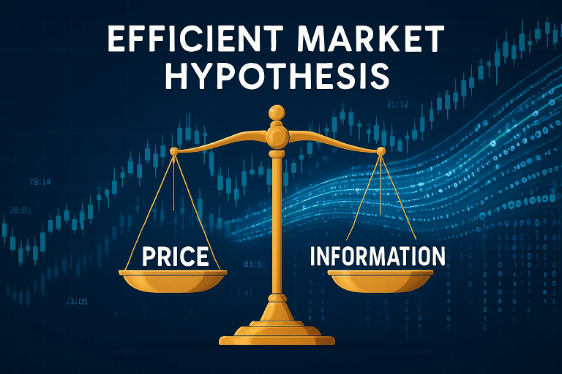
His thesis, in a nutshell, was that the price of a publicly traded stock is, almost by definition, the market’s best estimate of what that company is worth given everything publicly known about it. Its revenues and the history of them. Its profits and the history of those. Its products, its marketing, and its share of the market it competes in. And if that is right, it is close to impossible to make money consistently as a stock picker – because everyone you are trading against knows what you know. Every investor selling when you are buying. Every investor buying when you are selling.
The first time I read about the EMH, I thought it was interesting – but it struck me as just an elegant piece of academic mischief.
Today I see it differently. I think the logic is very nearly indisputable. Well… sort of. It is also refutable in one specific place. And that specific place turns out to be where all the money is.
Before I get to that, I want to give the theory its due, because it has gotten much truer in my lifetime.
When stocks were traded by human beings holding paper slips on the floor of an exchange, there was a good deal of difference between what one trader knew about a company and what the trader across from him knew. And it stands to reason that the better-informed man had an advantage.
But by the beginning of this century, that had largely gone. Every trader on every floor had the key numbers on any business he cared about. The basics were in the company’s annual report, and anything significant that happened turned up in the financial press within hours.
And now, the amount of information available on any company is almost infinite. It is also nearly instantaneous. Thank the internet for that – and, lately, Artificial Intelligence.
An ordinary investor can spend a few hours learning how to talk to an AI chatbot (e.g., Claude) and then build himself an “agent” that will fetch everything a company has published and everything published about it. All the recent action in the stock. All the professional analyses. The economic weather in the industry. Day-to-day sales activity. New product launches. Legal and regulatory trouble. Hirings and firings in the executive suite. Anything and everything that might bear on the price, free, waiting in his inbox before he has finished his coffee in the morning.
But here’s the thing…
Despite all of this information, the price of a share of stock is still nothing more than the number that all the people trading it, as a group, arrive at.
This is how somebody once put that to me: The price of a stock is not anybody’s estimate of what the company is worth. It is the number at which the last remaining optimist and the last remaining pessimist ran out of disagreement.
Three Claims, in Ascending Order of Nerve
In preparing to write this chapter, I outlined my thoughts to Nigel, my AI-created British butler and occasional advisor, just before he left for a long weekend in Cambridge with Margaret and the children. (Cambridge is where he went to university and where he met Margaret.)
When he returned, I summoned him to the library to share an after-dinner cognac and tell me what he made of the notes I had scribbled down.
He asked if I knew that Fama had continued to refine his hypothesis after publishing those first papers, eventually sorting it into three separate versions.
I did not know that, so he explained that Fama published the three versions of the EMH in 1970 – six years before a man in Pennsylvania built the first index fund that an ordinary person could buy, without ever having heard of any of it. (We will come back to him later.) And he offered to describe the differences. It might raise my understanding of the hypothesis, he said, to “a more elevated level.”
I told him I was eager to take the ride.
“The weak version,” Nigel began, “says that prices already reflect everything contained in a stock’s price history – which is a polite way of saying that chart-reading does not work.” And he added that, in his opinion, this version is broadly right.
“But if chart-reading doesn’t work,” I said, “how does the EMH explain the patterns technical analysts are forever finding in price charts?”
“If you look for it,” he said, “you will see the same patterns in clouds.”
I shrugged.
“The semi-strong version,” he continued, “says that prices reflect all publicly available information. Earnings, filings, news, the annual report you have been meaning to read. This is the version that matters to ordinary investors, because it says that everything you can legally look up has already been looked up.”
“What do you think of that one?” I said.
“In big, liquid, heavily watched markets, the evidence for it is uncomfortably persuasive,” he said.
“And the third version?”
“The third version, the strong version, says that prices reflect absolutely everything, including what a company’s insiders know.”
“That doesn’t make sense, I replied. “If that were true, there would be no reason to have laws against insider trading because the value of the inside information would already be in the price and it – the price – wouldn’t go up.”
“Precisely, sir.”
“And Nancy Pelosi and AOC wouldn’t be so rich!”
“To be fair, sir, they are not the only politicians who are said to have played at that game.”
“Right, Nigel. You must be referring to… what’s his name in New Jersey? Oh, Josh Gottheimer. And that Ro Khanna guy in California. And Ron Wyden in Oregon.”
“Well done, sir. But there are plenty of Republicans on that list too. Tommy Tuberville in Alabama, Michael McCaul in Texas. Kelly Loeffler in Georgia, Richard Burr in North Carolina…”
“Okay, okay,” I said, waving my hands at him. “But the point is there are still things that the average investor cannot know about the company whose stock he is evaluating.”
“And that’s not to mention perhaps the biggest unknown of them all,” said Nigel.
“Which is?”
“It’s…”
“Wait! Don’t tell me. I know. It’s market sentiment!”
“That’s correct, sir. The thing that can never be predicted reliably is how the individuals comprising the stock market react to any given piece of information.”
“A lesson that stock market history keeps teaching us,” I said. “The human mind is irrational.”
“A fact I am intensely aware of,” Nigel replied with a twinkle in his eye.
“I’m sure you are, I said. “Now please get me another cognac.”
Coming Next…
Chapter Three: The Question That Can’t Be Answered
Worth Considering
Three Quick Bites

“You’re Eating Your Way to Colonic Diverticular Disease”
Good headlines make you want to read what follows. The headline above – from this article by Dr. Peter McCullough – is short and straightforward, promising to reveal some surprising information. It grabbed my attention, and I’m glad it did. Check it out and let me know what you think.

Behind the Scenes
A fascinating account of the making of One Flew Over the Cuckoo’s Nest.

Welcome to the Third World
Nate Friedman has a way of doing his interviews that is unique. I can’t identify exactly what he does that makes me smile at his work, even when the subject matter is appalling – as it is in this clip.
Worth Considering
Postscript: Everything is moving at Moore’s Law speed!
I was just joking about how this will be the future of hair salons.