There are certain ideas – crazy, hypothetical ideas – that survive every encounter with reality. Perpetual motion is one. Time travel is another. For centuries, intelligent men have been trying to prove that both could be achieved.
Each failure should have weakened their resolve. Oddly, it often did the opposite. It merely persuaded the believers that everyone before them had done it wrong.
When I was about 12, my father introduced me to the idea of perpetual motion, explaining that many men of science and imagination had attempted to invent a perpetual motion machine. I took the bait and spent several months attempting to invent a perpetual motion machine of my own.
The design in my head involved a kind of conveyor belt that would enter a fish tank at the bottom and, subjected to the buoyant force of the water, start to move upward to the top of the tank, where, subjected to the pull of gravity, it would start to move down again. The problem, of course, was finding something that had enough density to be subject to gravity but not so much that it would not also be subject to the buoyancy. (That and keeping the system watertight.)
I gave up on my machine after several tries, but I have maintained an interest in perpetual motion. In some part of my brain (not the rational part), it seems like such an obviously useful thing that someone should – and, sooner or later, will – figure out how to do it.
Socialism may be the most consequential example of this peculiar human habit of refusing to abandon bad ideas. For nearly 100 years, it has been proven that it can’t work, only to rise again.
What I’m Talking About – and What I’m Not

After the first piece I wrote about Zohran Mamdani’s plans for New York, I got the usual pushback from people who think of me as a crusty old reactionary, incapable of opening my heart and mind to new and better ideas. “You’re talking about a few failed attempts at Socialism,” I was told. “You should be thinking about how it can be made to work in the future.”
“But it’s never worked,” I said. “There is something fundamental that dooms it from the start. Why do you think it could work?”
“Because it’s a beautiful idea.”
Is it?
Before my Scandinavian readers begin firing off angry emails, an important distinction. I’m not talking about Denmark, Sweden, Norway, and Finland. They are not Socialist economies. They are Capitalist economies with generous welfare systems. The same is true of France, Belgium, Spain, Italy, and Japan – all of whose social spending ranges from 20% to 30%. (For comparison, US social spending as a percentage of its GDP is 19%.) All of these countries create wealth through free markets and then choose to redistribute more of it than we do.
Nor am I talking about China today – a country that calls itself Socialist while allowing private businesses, private property, stock markets, billionaires, and foreign corporations. The part of China that produces its wealth looks suspiciously like Capitalism.
None of those countries took the Socialist proposition seriously – the proposition that private ownership creates exploitation, that markets produce chaos and inequality, and that the State, acting in the name of the people, can organize economic life more fairly and intelligently.
There have been plenty of attempts to make Socialism work. It has been tried in large countries and small ones. In Europe, Asia, Africa, Latin America, and the Middle East. In industrial nations and agricultural ones. In countries with oil, minerals, fertile land, and well-educated populations. It has been tried by revolutionaries, professors, soldiers, peasants, nationalists, and professional politicians.
The details were different. The endings were remarkably similar.
How It Starts
It usually begins with promises that everyone likes. Cheaper food. Free transportation. Affordable housing. Universal childcare. More fairness. Less inequality. If all you hear are the promises, it’s difficult not to nod along.
The problems begin when the government starts deciding what prices should be, what profits are acceptable, who deserves to own productive assets, and (eventually) who should produce what.
That’s when economics quietly takes over from politics.
The First Great Attempt
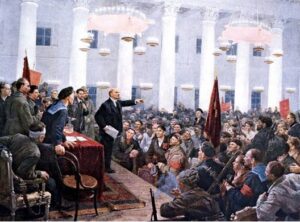
After the Russian Revolution, the Bolsheviks began replacing private ownership and markets with State control. Farms were collectivized. Factories, banks, transportation, and trade were nationalized.
At first, the results looked impressive. The Soviet Union industrialized rapidly and transformed itself from a mostly agricultural country into a military superpower. Socialists around the world pointed to this as proof that Socialism worked. And it did work, in a way. If you are willing to force millions of people to move, work, surrender their property, and accept whatever wages and living conditions the government assigns them, you can build a great many steel mills.
What the Soviet system could not do was produce ordinary abundance. It could build missiles. It had trouble producing decent shoes.
Factories were rewarded for meeting production targets, so they met them. If the plan required a certain number of nails, factories made millions of tiny nails. If the target was measured by weight, they made enormous nails that nobody needed.
Agriculture performed even worse. Russia had some of the richest farmland in the world, yet the Soviet Union repeatedly struggled to feed itself. Citizens routinely stood in line for bread, meat, shoes, even toilet paper. By the 1980s, shortages, waste, and stagnation had become normal. The system did not collapse because the planners were stupid. It collapsed because no group of planners, however intelligent, could process the billions of changing decisions that a functioning economy requires.
In 1991, the Soviet Union disappeared. But by then, many other countries had volunteered to repeat the experiment.
The Laboratory of Eastern Europe
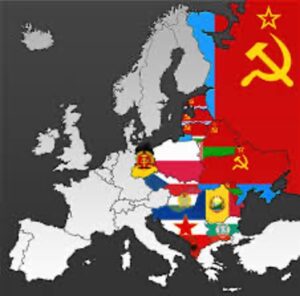
After World War II, the Soviet model was installed across Eastern Europe.
East Germany should have been Socialism’s finest advertisement. An educated population. A strong industrial tradition. The most productive economy in the Eastern Bloc. Unfortunately, it sat next to West Germany, which made comparisons awkward. West Germans – same language, same history, same culture – had better housing, better cars, better food, higher wages, and greater freedom. East Germans noticed, and so many of them fled that the government built a wall to keep the rest of them in.
This was an unusual form of consumer protection.
Poland nationalized industry and got shortages, debt, inflation, and a workers’ rebellion – “Solidarity” – against a system that claimed to represent workers.
Hungary tried a softer version – “Goulash Communism” – and merely fell behind more politely.
Czechoslovakia began with one of Europe’s strongest industrial economies, but four decades of central planning left it technologically behind the West. And when reformers tried to liberalize during the Prague Spring of 1968, Soviet tanks defined the limits of experimentation.
Romania under Ceaușescu delivered scarce food, cold apartments, and an enormous palace for the leader. Another recurring Socialist achievement: equality of sacrifice, except at the top.
Albania pursued ideological purity all the way to becoming one of the poorest countries in Europe, pouring what economy it had into 170,000 concrete bunkers.
Yugoslavia tried something different: “worker self-management.” Instead of having every enterprise run directly by government ministries, factories were nominally controlled by their employees. The system was more flexible than Soviet planning and allowed greater trade with the West.
For a while, it looked like a successful middle path – and it is worth a second look, because worker control is precisely what today’s Democratic Socialists say “real Socialism” would look like. But then inflation, unemployment, foreign debt, political interference, and regional resentment began pulling it apart. By the 1980s Yugoslavia’s economy was in deep trouble, running on foreign loans.
One by one, these countries abandoned central planning. None voted to bring it back.
The Chairman Takes It Further
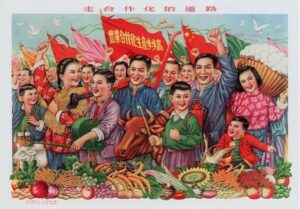
China under Mao Zedong went further than the Soviets. During the Great Leap Forward, villages were organized into giant communes. Private farming was abolished. Families surrendered their cooking utensils to communal kitchens. Peasants were ordered to produce steel in backyard furnaces, though most of what they made was useless.
Local officials, eager to please their superiors, reported harvests that had never occurred. The State then collected grain based on those imaginary numbers. Villages were left without enough food. The result was the deadliest famine in recorded history. Somewhere between 30 million and 40 million dead. Not because China lacked farmland, but because central planning proved catastrophically bad at farming it.
After Mao died, Deng Xiaoping began quietly dismantling the system. Farmers were allowed to keep and sell some of what they produced. Private businesses reappeared. Foreign investors arrived. Prices were increasingly set by supply and demand. China then experienced one of the greatest economic expansions in human history.
Vietnam and Laos discovered the same thing. Both imposed collectivization and central planning after 1975. Both got stagnation, shortages, and inflation. Both adopted market reforms in 1986, after which both economies took off.
Cambodia’s Khmer Rouge attempted the most extreme version of Socialism. Money, markets, private property, schools, and even cities were abolished almost overnight. Roughly a quarter of the population died from execution, starvation, disease, and forced labor.
When the State controls food, property, employment, and political authority all at once, the consequences of its mistakes multiply.
A Never-Developed Idea Goes to Undeveloped Countries
Then came the third wave: developing nations that believed Socialism offered a shortcut to modernization.
Burma invented “the Burmese Way to Socialism,” and turned one of the more promising economies in Southeast Asia into one of the poorest.
Tanzania offered a gentler version. Julius Nyerere was modest, smart, and by most accounts sincere. His Ujamaa program of communal villages sounded humane. Then millions of country people were moved, sometimes by force, into collective settlements. Output fell, and a country that had sold food abroad began buying it. Nyerere’s intentions were better than Stalin’s, but the arithmetic was the same. Farmers do not work as productively when the decisions are made for them and the rewards are cut loose from their effort.
Ethiopia’s “Scientific Socialism” under the Derg helped deliver the catastrophic famine of the 1980s. Somalia’s version ended in outright State collapse. Angola and Mozambique won Marxist independence, then got decades of shortage and civil war. South Yemen – the Arab world’s only Marxist State – gave up and merged with its neighbor. In Afghanistan, the Communist government collectivized its way into rebellion, invasion, and collapse.
Socialism failed in industrial nations and agricultural ones. In democracies and in dictatorships. In Christian, Muslim, Buddhist, and Confucian cultures. In Europe, Asia, Africa, and Latin America. It was not the mistake of one continent or one culture or one century. The details changed. The ending didn’t.
Socialism Failures in North and Central America

Cuba is often held up as the exception. It did reach high literacy, and it did give most people basic medical care. Those are real accomplishments, and they should be acknowledged. Cuba also leaned on massive Soviet subsidies. When the Soviet Union fell, Cuba entered what it called the “Special Period.” Food, fuel, power, and nearly everything else ran short. The government has since allowed some private business. Apparently even a revolutionary State needs somebody to run a restaurant.
Nicaragua under the Sandinistas took over more of the economy, imposed controls, and tried to steer where the money went and what got made. What it got was hyperinflation and a catastrophic drop in living standards. Yes, the country was fighting a US-backed insurgency, and that did real damage. But the deficits, the printing presses, and the price controls were homegrown. The Sandinistas lost the 1990 election. When they came back to power, they came back friendlier to markets.
Venezuela may be the saddest case. It began with nearly every advantage imaginable: the largest proven oil reserves on earth and a place among the richest countries in Latin America. Hugo Chávez expanded social programs, nationalized private firms, and set prices and exchange rates by decree. And for a time, it seemed to work. Oil money covered the losses. Imports filled the stores. Venezuela became proof that Socialism had at last found the right country and the right leader.
Then oil prices fell. Production had already been hollowed out. Politics had crept in, investment had dried up, and experienced workers had been swapped for loyalists. Price controls created shortages, and currency controls created corruption. The government paid its bills by printing money, and inflation ran past a million percent a year. More than seven million Venezuelans left to look for food, medicine, and work.
Sanctions made things worse. So did corruption. So did the fall in oil prices. But none of that explains why one of the most resource-rich countries on earth could no longer produce food, electricity, gasoline, or a stable currency. Venezuela had oil under its feet. What it lacked was a system that could turn that oil into abundance.
The Usual Defense
At this point, the standard objection appears: These are not examples of “real Socialism.” Real Socialism would be democratic. Real Socialism would not be corrupt. Real Socialism would not be run by dictators, generals, party bosses, or murderous fanatics.
It’s an ingenious argument, because it can’t lose. Every failure simply proves the next attempt will finally get it right. Imagine using that logic anywhere else. “The plane crashed because it wasn’t real aviation.” “The bridge collapsed because it wasn’t real engineering.” At some point even the most charitable observer begins to suspect the blueprint rather than the builder.
And the objection avoids the harder question: Why do Socialist experiments so often produce concentrated political power?
The answer may be built into the system itself. The State decides who controls land, businesses, capital, employment, prices, wages, credit, and production. And when economic power is centralized, political power follows.
Why It Keeps Failing

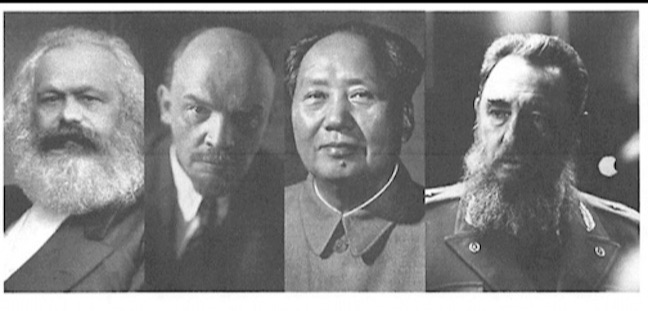
Karl Marx wasn’t stupid. Neither is Zohran Mamdani. Neither are the professors, journalists, and mayors who still believe government is the best way to manage an economy. Many are intelligent, decent people who were rightly disturbed by poverty, exploitation, and inequality. They saw real defects in Capitalism.
The mistake they made is believing an economy can be managed like a government agency. A limited purpose. A plan to achieve it. And a leader with the power to make the decisions.
But an economy has no single purpose. It is a living organism made up of millions of people making tens of millions of decisions every day – about what they want, what they know, what they can do, what they are willing to risk, and what they are willing to pay. Profits tell business owners where resources are needed and whether society values what they make. Take profits away and you don’t eliminate greed. You eliminate information.
Socialism appeals most to people who think they understand how wealth should be distributed but have never had to create it. People who have never signed the front of a payroll check instead of the back. Never watched customers vanish because they raised prices 1% too high.
The Socialist plan looks tidier than Capitalism, but reality refuses to cooperate. That is why Socialist countries eventually permit private farming, private trade, foreign investment, and market prices. Though they may continue calling their system Socialism, they are reluctant to admit that the street vendors, shopkeepers, and small businessmen they spent years suppressing are the people keeping the country alive.
The great flaw in Socialism is not that nobody has found the right formula. It is the belief that there could be one.
Which brings me back to New York.
New York has run the fiscal experiment before, too. In 1975, a city offering free tuition, sprawling payrolls, and generous benefits came within hours of default, saved only by a bailout and years of imposed austerity.
The New Look – Good Luck, Guys!

I could be wrong. I’ve been wrong before. If someone can point me to a country – or, these days, a city – where government took control of production and the distribution of wealth and produced greater prosperity, greater freedom, and a higher standard of living than a market economy, I’d genuinely like to study it.
Meanwhile, the early returns from New York – the stalled buses, the sued-over rent freeze, the grocery stores hunting for private operators, the purged advisory board – are following the script.
Different century, different city, same blueprint. The promises come first. The price controls come next. Then, quietly, the people who create the wealth are removed from the rooms where the decisions are made.
New York, Seattle, Chicago – welcome to the experiment. We already know how it ends.
Worth Considering
Two Quick Bites
All In Your Head excerpt: “Psychiatry and the Isolated Demand for Rigor”
Another very smart little essay by Freddie deBoer.
Is this a good poem?
Serious question. I could not make up my mind. What do you think?
Walking in the Woods of Boedo
By Daniel Durand*
Every day when I get home
from work I spend money
I don’t have on useless books.
Every day I come home from downtown
drunk. History remembers
few men who, in this way, have reached
the age of eighty. I look at the roof’s metallic membranes
sparkling under the moon; I hear
the long meows of cats gathered
on the terraces. I scream beneath the neighborhood wind,
facing the darkness and passing hours,
and I wonder why men
only think about things that torment us.
*Daniel Durand is a poet, editor, translator, and teacher from Concordia, Entre Ríos, Argentina.
Worth Considering
Postscript: Epic Piano Battle in a Train Station
Is that Lang Lang? YES!