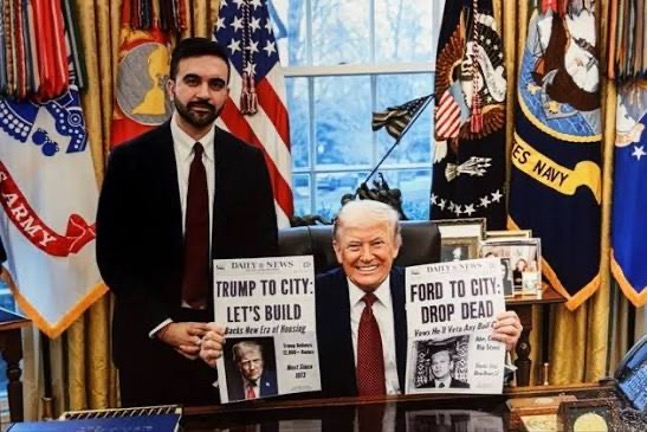
Since Zohran Mamdani was elected, he has been implementing his agenda – including many of his most popular campaign promises – with an intensity and an insensitivity to doubt that reminds me of the strategy Trump has been following in his second term in office.
There are some interesting parallels between the two men.
Like Trump, Mamdani had a pampered New York City childhood, an expensive, private education, and little political experience when he decided to run for one of the most important political offices in the world. And like Trump in 2016, he surprised everyone (perhaps even himself) and won.
Like Trump, Mamdani’s success was due in part to making smart decisions in terms of the promises he made. But it was equally due to an undeniable charisma – one that, like Trump’s, infatuated his fans as strongly as it infuriated his political opponents.
But the most striking similarity is that Mamdani did exactly what Trump did in 2024 (and has continued to do). Knowing that he would face a considerable amount of pushback from the entrenched bureaucrats he planned to bully, the NYC residents who were not happy about having an out-of-the-closet Israel-hating Communist at the helm, and the billionaires he wanted to tax into oblivion, he launched a blitzkrieg of legal, political, regulatory, and public-relations initiatives that are too many and, in many cases, too outrageous for anyone on the other side of the sanity aisle to establish a good strategy to thwart them.
Here’s a sample of what I’m talking about…
A New Old Idea: City-Owned Grocery Stores


Mamdani’s most effective campaign theme was to “make NYC affordable again.” Most of the political pundits I’ve read say that was his winning hand – that it was the right thing to say at the right time, and that it worked especially well with middle-aged, upper-income women and virtually all voters under 30.
Students of economic history know that the most effective way of making things more affordable in a free market is to increase supply. And the way to increase supply is to make it easier for entrepreneurs to start businesses to compete against the ones that are already there.
But that would be a free-market solution, and Mamdani is not a free-market guy. To his credit, he never even pretended he liked laissez-faire, free-market economic policies. He was a proud Socialist, and he favored government-mandated pricing policies and, whenever possible, government ownership of the businesses involved.
That’s why he made such a big deal about establishing city-owned grocery stores. His idea was that instead of relying on private supermarkets competing with one another to bring down prices, he would have the city itself do it. The stores would be managed by private players, people selected by the city, and might even make a profit – a warm and fuzzy objective that the city would help these managers achieve by giving them free rent and all sorts of other free services that local grocery stores don’t have. And before the paint on his new office had dried, he had committed roughly $70 million to launch five city-owned grocery stores, one in each borough.
There are so many things wrong with this idea that I don’t have time to list them all here. The most obvious problem is that the city-owned stores, if successful, will put dozens of privately held supermarkets, grocery stores, and bodegas out of business. And because, ultimately, it will be a Socialist enterprise run without a profit motive, the chances of these stores not going bankrupt in a few years, despite all the tax-supported handouts they will be getting, is just about zero. (Not that Mamdani and his ideologically dedicated appointees care about that.)
The idea of government-supported grocery stores has been tried again and again over the last 50 years, and it has never worked. Not just “hasn’t worked” but has, in every case, failed miserably.
* Kansas City tried it. The city poured millions of taxpayer dollars into the KC Sun Fresh store, and it closed anyway – shelves thinning, losses mounting – just last year.
* Baldwin, Florida, a small town that opened its own municipal grocery in 2019 to national fanfare, shut it down in 2024 because it kept losing money.
* Venezuela ran a national chain of subsidized state groceries – Mercal and PDVAL – that became famous for two things: empty shelves and a corruption scandal involving thousands of tons of imported food left rotting in port containers while the stores had nothing to sell.
Cuba has run state groceries for 60 years. They operate on ration books, and Cubans line up outside them at dawn. And New York’s own bodega owners – many of them immigrants who have seen this story play out in the countries they fled – understand the ending well enough that a coalition of them has reportedly gone to court to stop Mamdani’s program before the first store opens.
Free City Buses

Mamdani went to work quickly on this agenda item too, reorganizing parts of the city’s transit planning and hiring leftist-leaning managers to figure out how free transportation could work.
The benefit was easy to understand and appealing to any New Yorker who used the city’s bus system – but so far, they have made little progress. There are a few bus lines that are doing a better job of running on time, but no one has figured out how to make buses free in the Big Apple without sending the city’s budget into a nosedive. So the fare-free proposal is stalled, and nobody in Mamdani’s administration is talking about it anymore.
They could have saved themselves the trouble by reading a little transit history:
* The federal government paid for fare-free experiments in Denver and Trenton in the late 1970s. Both were abandoned.
* Austin tried it in 1989 but gave up within a year.
* And the biggest one just ended. Kansas City, the first major American city to make all its buses free, ran its experiment for five years, watched the budget hole widen, and went back to charging fares.
The pattern is always the same. Ridership goes up, revenue goes to zero, service decays, and the city quietly rediscovers the fare box.
A Rent Freeze for Rent-Stabilized Apartments
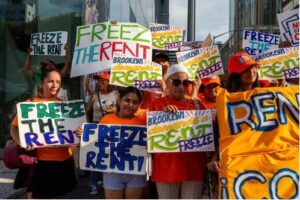
NYC already had a fair amount of rent-regulated housing when Mamdani took office, but his ambitions are very strong in this area and he moved quickly, appointing six Socialists to the nine-member Rent Guidelines Board.
The board delivered on his campaign pledge in June, freezing rents on roughly a million rent-stabilized apartments. The landlords are suing, alleging a “sham process with a predetermined outcome,” but it hardly matters. The freeze is in effect – which is exactly what Mamdani’s blitzkrieg strategy was designed to achieve.
Like free transportation, rent control has a long history of being tested in all sorts of cities. It has done nothing but reduce the supply of new housing and leave the old housing without management that has any motivation to make it a better place to live – but that is not something Mamdani and his crew are worried about. They get their ideas from failed idealists. They are not willing to allow the facts of history to get in their way:
* When San Francisco expanded rent control in 1994, the city’s rental supply fell about 15%, and rents across the city went up.
* When St. Paul capped rent increases at 3% in 2021, new housing construction collapsed within months. The city spent the next four years carving out exemptions and walking the law back.
* In Massachusetts, the city of Cambridge ran the experiment in reverse. It abolished rent control in 1995… and property values and new investment promptly jumped.
* New York itself supplied the grimmest chapter. In the 1970s, owners of regulated buildings in the Bronx and Brooklyn, squeezed between frozen rents and rising costs, stopped maintaining their buildings, then stopped paying taxes on them, then walked away from them altogether. Whole blocks were abandoned. Some burned.
Higher Taxes on Wealthy Individuals and Corporations

This is the purest expression of Mamdani’s redistribution agenda: To finance the expanded public services, he has proposed increases on high-income earners and corporations and has supported new levies such as a pied-à-terre tax on luxury second homes.
And here, the blitzkrieg has met a wall: Albany. New York City cannot raise these taxes on its own. It needs the support of the state legislature and the governor, and the governor has so far shown little appetite for it. Some targeted measures have advanced, but the broader tax agenda remains stalled in the state capitol.
This may be a blessing for Mamdani because this experiment, too, has a long track record:
* France introduced a 75% supertax on high earners in 2012. It raised a fraction of what was promised, chased some of the country’s most productive people to Belgium and London, and was quietly abandoned after two years.
* Maryland passed a millionaire’s tax in 2008. The following year, a third of its millionaire filers disappeared from the rolls.
* New Jersey discovered that a single billionaire, the hedge-fund manager David Tepper, could blow a measurable hole in the state budget just by moving to Florida.
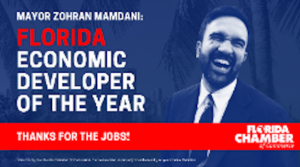
It’s interesting to note that the Business Development Board of Palm Beach County bought billboard space in Times Square promoting its “Wall Street South” campaign designed to woo financial firms away from Manhattan. And Florida’s so-called “breakup ads,” timed with the New York City mayoral elections and the tax hikes proposed by then-candidate Mamdani, proclaimed, “Dear NYC, it’s not you. It’s me.”
Here’s an example:
New York’s tax base is the most top-heavy in the nation. A small number of very wealthy households supply an outsized share of the revenue, and they are precisely the people with the means – and, increasingly, the motivation – to leave. You cannot redistribute the income of people who no longer live in your city.
Universal Childcare

Within days of taking office, Mamdani negotiated a major funding agreement with Governor Hochul – a $1.7 billion plan to begin delivering free childcare, starting with all two-year-olds. Funding has been secured and implementation has begun, though universal coverage remains several years away. It is his clearest success so far.
It is also the least Socialist item on his list – a subsidy, not a seizure. But even here, history urges caution. Quebec built the most famous universal childcare program in North America, beginning in 1997 with five-dollar-a-day care. Demand swamped supply immediately, waiting lists became a permanent feature, costs multiplied far beyond projections – and the most careful study of the program found that the children in it did measurably worse on behavioral and health outcomes than comparable children.
Publicly Subsidized Housing
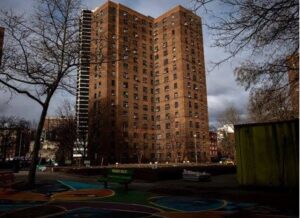
Mamdani continues to advocate construction of roughly 200,000 publicly supported affordable-housing units, backed by zoning reforms and public investment. So far this is planning, not building. The program remains in its early stages, a long-term objective rather than an accomplished fact.
But we don’t need to wait for the results because the city is already the largest public landlord in America. The New York City Housing Authority owns hundreds of thousands of apartments and carries a repair backlog estimated at roughly $80 billion – mold, lead, broken elevators, no heat. That is what decades of public stewardship have produced.
The federal government’s grand experiments in publicly built housing ended no better. St. Louis dynamited its Pruitt-Igoe towers on national television in 1972, barely 20 years after they opened, and Chicago spent the 1990s and 2000s tearing down Cabrini-Green and Robert Taylor Homes.
And now a city that cannot maintain the public housing it already owns is proposing to build a great deal more of it.
Expanded Tenant Protections

Here the administration has been busy. It has announced tougher enforcement against landlords, new tenant protections, and a program aimed at what it calls deceptive rental practices.
Some of that is perfectly defensible. Fraud is fraud, and dangerous buildings should be repaired. But Mamdani wants to go much further. His administration has set aside $2 billion to take housing from what he calls “exploitative landlords” and put it into “tenant and community control.” He has specifically talked about targeting the city’s worst landlords and transferring their buildings to nonprofits, community land trusts, or the tenants themselves.
That might sound like a good idea to someone who knows nothing about the economics of rental real estate, but think about what he’s saying…
His housing board is freezing owners’ rents while their costs – taxes, insurance, labor, utilities, and repairs – continue to rise. Then the board will be increasing enforcement, which may be a good thing if it is applied to slumlords. But if it is a strategy to increase city-owned residential apartments, it is a terrible idea. As I said above, NYC already has the largest portfolio of public housing in the country. And the buildings it owns and operates are as or more dirty, dangerous, and dumpy as the privately owned buildings Mamdani has pledged to seize.
Transferring ownership doesn’t repair the roof or replace the boiler. If the economics didn’t work for the landlord, they don’t suddenly work because the tenants or a nonprofit owns the building. Somebody still has to supply the missing money – which usually means the taxpayer.
Government-directed transfer of private property into collective ownership has been a hallmark of Communism since Communism was invented. Mamdani isn’t proposing Soviet collectivization. But he is proposing something that should make anyone who believes in private property nervous: Government decides an owner has failed. Government removes him. And government helps decide who gets the property next.
New York has seen what happens when owning marginal rental property becomes economically irrational. In the 1970s, the result was disinvestment, abandonment, and eventually entire neighborhoods filled with burned-out buildings.
Mamdani and his followers have forgotten that. And they don’t seem to be concerned about the flight of capital from the city that these announcements have already caused.
I’ve seen estimates of $11 billion to $17 billion since he took office. That translates into several hundred million dollars’ worth of tax revenue that the city won’t see in 2026 and will probably never see again. If Mamdani continues with this craziness, there will be tens of billions more that disappear.
That’s the thing about capital. It doesn’t have to announce that it’s leaving. It just stops coming.
And Now… the Board Room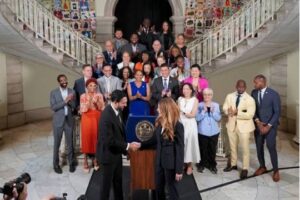
On August 3, Mamdani did something that tells you more about the direction he is going in than any policy paper. He dismissed the entire advisory board of the Mayor’s Fund to Advance New York City (the nonprofit that channels private philanthropy into public programs), clearing out every business leader on it. The chairman of GFP Real Estate. The president of the Real Estate Board of New York. Senior executives from Citigroup and Blackstone. His office says the reconstituted board will be drawn from “working New Yorkers and advocates who organized and fought for bold and progressive action on picket lines, protests, and public forums.”
The people who sign payroll checks are out. The people who carry signs are in.
And Mamdani is not alone – which is the part that should give a skeptic pause. In Seattle, voters just handed City Hall to Katie Wilson, a self-described Democratic Socialist. In Chicago, Mayor Brandon Johnson is patching a billion-dollar hole with a $16.6 billion budget and roughly half a billion dollars in new taxes, reviving a corporate “head tax” and inventing a levy on social-media companies for good measure.
New York just has the biggest marquee. The same show is playing in three cities at once.
The trouble is that good intentions have never repealed the laws of economics.
Where I Come Out, Seven Months In

On the one hand, Mamdani is following Trump’s playbook – overwhelming the bureaucracy, the courts, and the opposition with so many simultaneous initiatives that no one can organize an effective defense, and banking whatever gets through. As pure political technique, it is working. The rent freeze is in effect. The childcare money is flowing. The grocery stores are funded. The advisory boards are filling up with allies.
On the other hand, Mamdani’s proposals have all been tried before – many times, in many places, over more than a century.
And they have always failed.
Worth Considering
Two Quick Bites
Medical Examiner’s Wonky Conduct in Tyler Robinson Trial
There have been theories about Charlie Kirk’s assassination since day one. Similar to JFK’s assassination. I never paid attention to them, but John Leake is a credible source. Take a look at this piece by him in the Aug. 3 issue of Focal Points.
The WNBA is a truly f**ed up organization.
The owners and operators of the league have promoted and condoned every imaginable anti-feminist, anti-woman idiocy that popped up like whack-a-moles since it was founded in 1996. And considering the league has been losing $50+ million every year, despite being subsidized by the NBA, these nitwits don’t seem to be worried that if they continue on the path they’ve chosen, there will be no such thing as professional basketball for women in another few years. That would be a shame, considering the level of excitement that can be generated when the superstars of the sport are allowed to show why they sell out their shows.
This, for example, is the last three minutes of a recent Indiana Fever game, where Caitlin Clark scored a record 45 points (with 10 assists) to win the game.
Entrepreneurship
Readers Write: JJ asks for my advice on copy/speechwriting as a second revenue stream
From JJ: “I started Automatic Wealth last week after seeing you on DIY Wealth. Total game changer. It has really helped me make a plan for what the future needs to look like.
“I’m 31, in my fifth year with a small marketing firm – and I’m wondering what your advice would be for someone considering a freelance copy/speechwriting consultancy as a second revenue stream. I wear a lot of hats with my firm currently (project management, grant writing, partnerships, biz dev, etc.) but my academic background is in technical writing and government. I’d love to continue to build on those skills/interests and use them to generate some business for myself.”
My Response: I like the fact that in year five of a demanding job you are looking to create a second stream of income. You are the same age I was when I decided to get rich – and less than 12 months after that, I was working on my second income stream (investing in rental real estate).
You are obviously very motivated. And you seem perfectly happy to work 60+ hours a week, which is what a person needs to be willing to do to ensure success in anything. As for attempting a side career in copywriting, my advice is this: Why not? It’s not only an opportunity to develop a second income, it’s an opportunity to develop a financially invaluable skill.
AI is changing the world in ways that are hard to keep up with, and direct-response marketing and the highly paid jobs that go with it will certainly be affected. I am still in touch with probably 50 actively working copywriters, and I think every one of them is at least experimenting with AI.
There may be an adjustment in the marketplace in terms of how much beginning copywriters can expect to be paid, but in your case, that doesn’t matter. The real money is in royalties – the dividends you get for writing breakthrough promotions. And even if your base compensation is brought down by AI in the next two to five years, I very much doubt that royalties will come down. When you write a breakthrough package, your client will be getting rich and happy to pay you the percentage you negotiated.
Even more important is the fact that whatever AI is going to do in terms of leveling some industries and professions, knowing how to persuade someone you don’t know personally to write a check for a product or service you are representing is a skill that will continue to be valued.
Worth Considering
Postscript: Jewish Rap
La Chaim to Happiness and Life… and Wine!